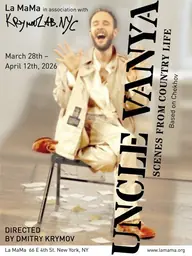
In Dmitry Krymov’s recent radical reimagining of Chekhov’s Uncle Vanya, domestic conflict merges with the violence of a country at war. The famous exiled director turns a classic drama into a disturbing portrait of contemporary Russia—but is it only the Russian audience that would recognize this depiction? Tracing the links between state power, misogyny, and complicity in Krymov’s production, Dana Fishman tries to answer this question.
Since 2022, nearly 200,000 soldiers According to state figures. Novaya Gazeta Europe puts the number two times higher.have returned to Russia from the front lines of the full-scale war against Ukraine, bringing back thousands of criminal convictions for which they had been incarcerated before signing a contract with the Russian military in exchange for official pardons. Now, having returned from the war, they’ve added to the nation new offenses that range from traffic violations to rape and murder.1 Regarding this risk—that some of the soldiers returning home might become reoffenders—President Putin remarked in 2023 that it was “inevitable,” and that the “negative consequences are minimal.”2 The men have come home to roost. And the women better watch out.
In Uncle Vanya, Scenes from Country Life, a radical rendition of Anton Chekhov’s 1896 play, exiled artist and director Dmitry Krymov picks up on this theme. In this new production, staged at New York’s La MaMa Theatre this past spring, he subverts Chekhov’s classic to confront the post-2022 Russian reality, paying special attention to gender and its interplay with the kinds of power and violence that have come back from the front. Krymov, who renounced his position at the Moscow School of Dramatic Art after the full-scale invasion of Ukraine, proclaims that he can no longer just watch in horror from the other side of the world. Instead, by creating, in English, a new classic of post-invasion Russian theatre, he exposes scenes from his country’s life for an international audience.
This painful excavation begins with a seemingly innocuous line from an early scene in Chekhov’s original:
Marina walks around the house, calling the chickens.
Marina: Chicka, chicka, chicka…
Sonya: Nanny, what do the peasants want?
Marina: It’s the same old, same old thing, still about that empty field. Chicka, chicka, chicka…
Sonya: Who are you calling then?
Marina: The speckled hen took off with her little ones… I worry the crows might snatch them…3
Krymov amplifies the mention of a hen by the old nanny Marina to meet the challenge of Russia’s new reality. In his version, the hen is now a character, as is a rooster, both of whom the audience first encounter in larger-than-life costumes. The Hen enters the stage first, playing with her chick (operated by remote control offstage, like a drone). Yelena enters the estate (stage) after the Hen, dressed head-to-toe in a dark and heavy turn-of-the-century upper class ensemble. As she strips off her clothes, desperately trying to get comfortable in the summer heat, the rest of the cast barrels in. Yelena must face them, her body vulnerable and exposed. As we are introduced to each character, Yelena—outsider, object, witness, accomplice, and audience-stand-in—remains at the center of the stage, and we start to suspect that the violence about to erupt will be aimed at the women.
When it is the Hen’s turn to meet Yelena, we realize they mirror each other. Like a backyard chicken, Yelena cannot take off, unable to escape the setting. Her role as the old Professor Serebriakov’s new wife—the lady of the house—is irrelevant; it only invites hungry eyes that lust for her attention. She is prey, and she is meat. Likewise, before the Hen can remove her feathers to strike up a “human” conversation with Yelena, she is dragged away to be raped by the Rooster. The cast, including Yelena, is seemingly unfazed, carrying on their conversation above the yelps and moans from the corner of the stage. This scene is played for a laugh that quickly gives way to nausea, as the audience cannot help but see the costumed Rooster as a faceless soldier—a hero of the “special military operation.” The horror is further reinforced when we learn that the violence has extended to the Hen’s chicks. In Chekhov’s original play, the chicks are at risk of being preyed on by crows, but in Krymov’s version all but one of the Hen’s twelve chicks have already been snatched by hawks.
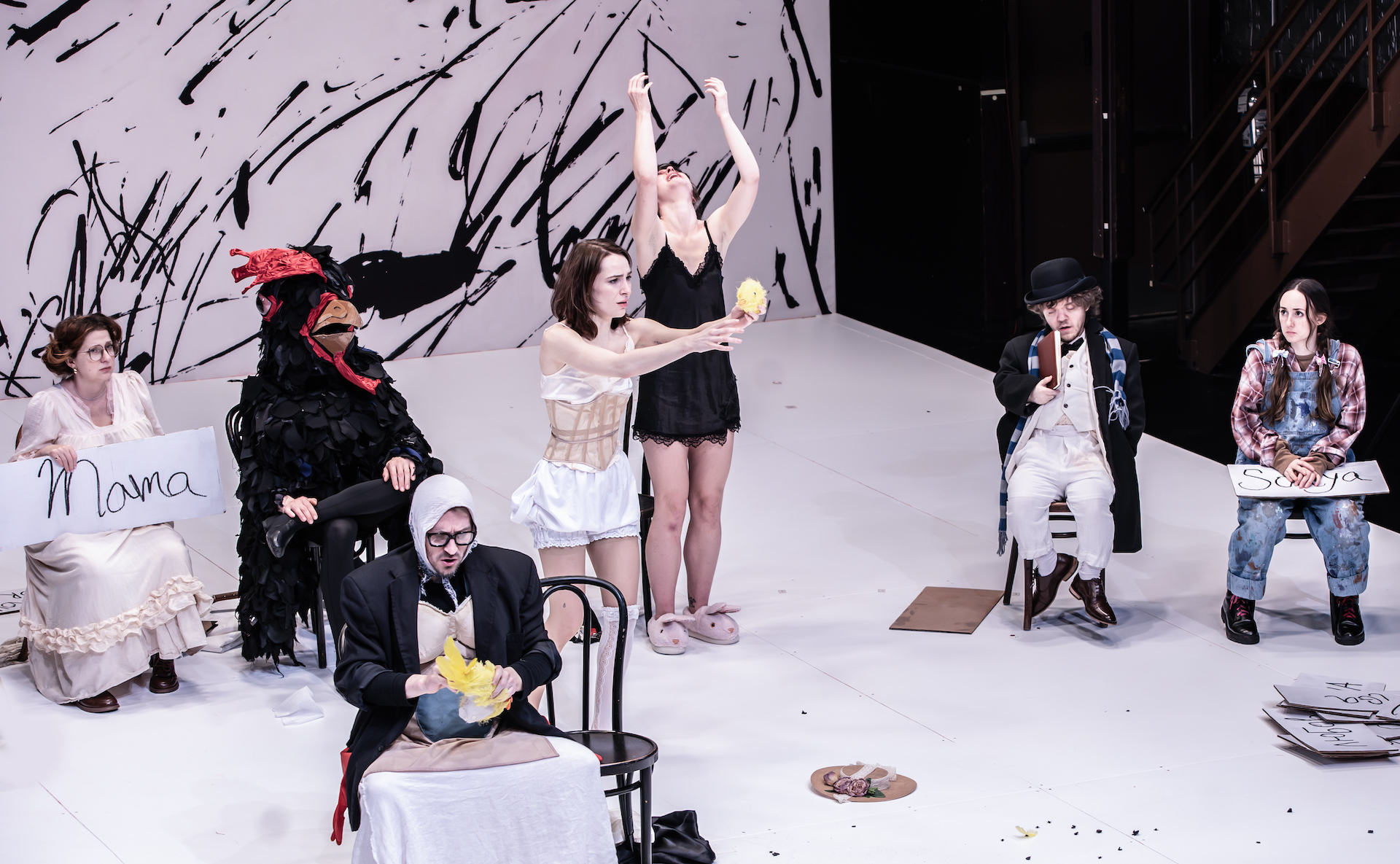
The hawks, however, are not the only predators going after the Hen’s children. Along with them is Krymov’s version of Marina, the nanny. Her form is that of a peasant woman, a Mother Russia of sorts, complete with heavy cloth breasts and stomach, a long skirt, and headscarf. Yet this is a male actor in babushka drag, and the production’s costume design isn’t trying to fool the audience: the character also wears a beard and, curiously, a stark black suit jacket. It is Father Russia pretending to be Mother Russia, who answers only to the desires of Professor Serebriakov, the owner of the estate unable to move on from his past days of glory.
What happens is this: the Professor, whose small stature is but a stark contrast to his self-esteem, has demanded soup. But the soup for the Professor, aka Dear Leader of the (e)state, must be made from scratch, and Krymov allows each step of the soup’s preparation to take place right there for the audience to see. First, mother Hen is raped by father Rooster. Then, Marina, still dressed as Mother-Father Russia, plucks and cooks the resulting chick. And who’s the one who feasts? Not the Professor at all. Instead, using Chekhov’s play as a horrible circus mirror, Krymov recruits Doctor Astrov, a nineteenth-century environmentalist, to get to the soup before anyone else. He chows down with a frightening fervor.
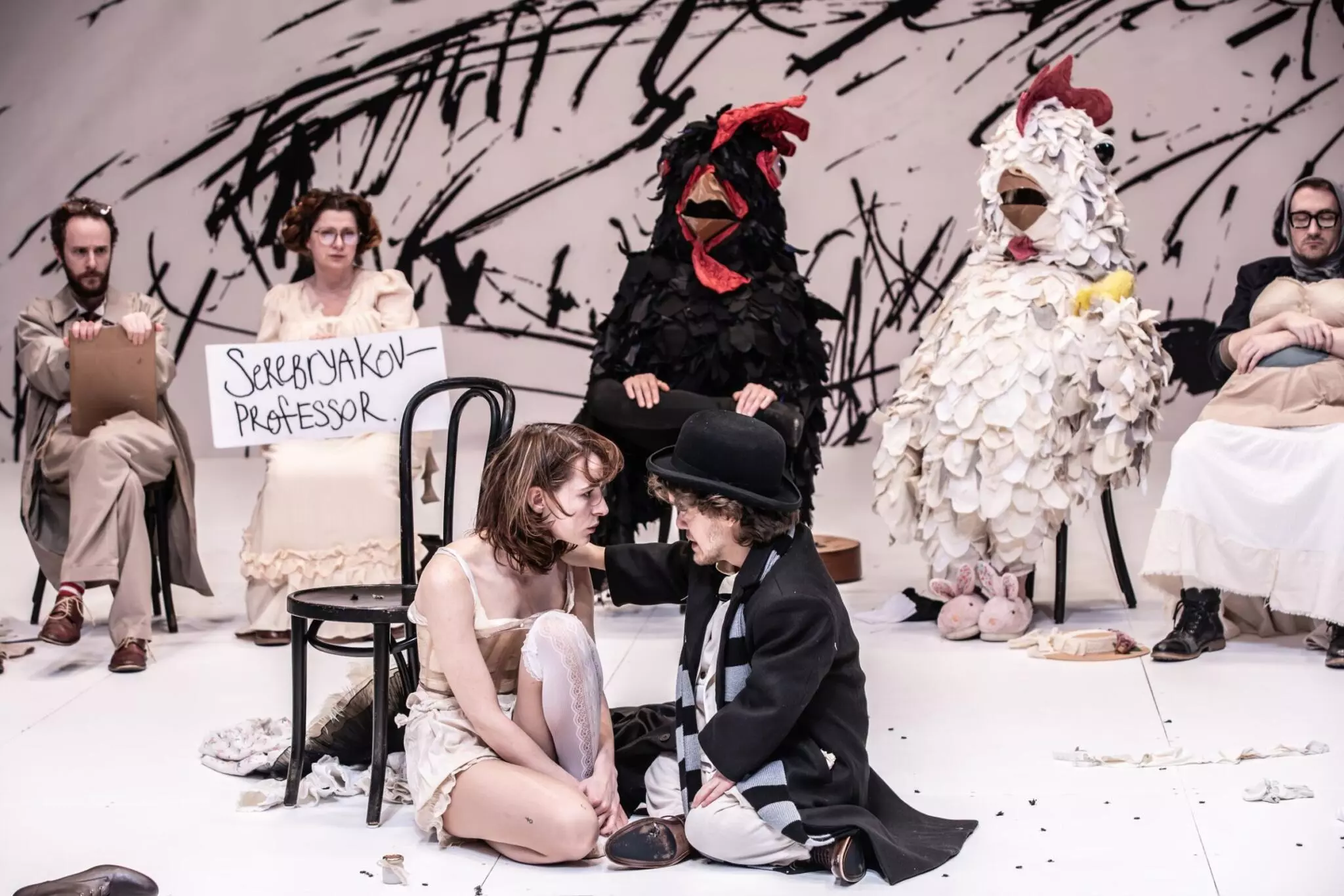
Chekhov’s original Astrov, discussing his disillusionment with humanity, prefers forests to people and proclaims himself a vegetarian:
I suffer unbearably sometimes, but I have no light in the distance. I don’t expect anything for myself, I don’t love people … I do have a soft spot for your Nanny—for old times’ sake … When [people] don’t know which label to affix to my forehead, they just say: "He’s a strange man, strange!" I love forests—that’s strange; I don’t eat meat—that too, is strange.4
Meanwhile, Krymov’s Astrov cannot stop gorging on chicken meat, compulsively stuffing mouthfuls with his bare hands. There is no one on stage who will stop the ghastly feast, or refrain from participating in it: the death of the chick is normalized by every member of the household. Only the Professor doesn’t directly partake; instead, he watches the gore from afar. The consequences, as Putin said, are “inevitable.”
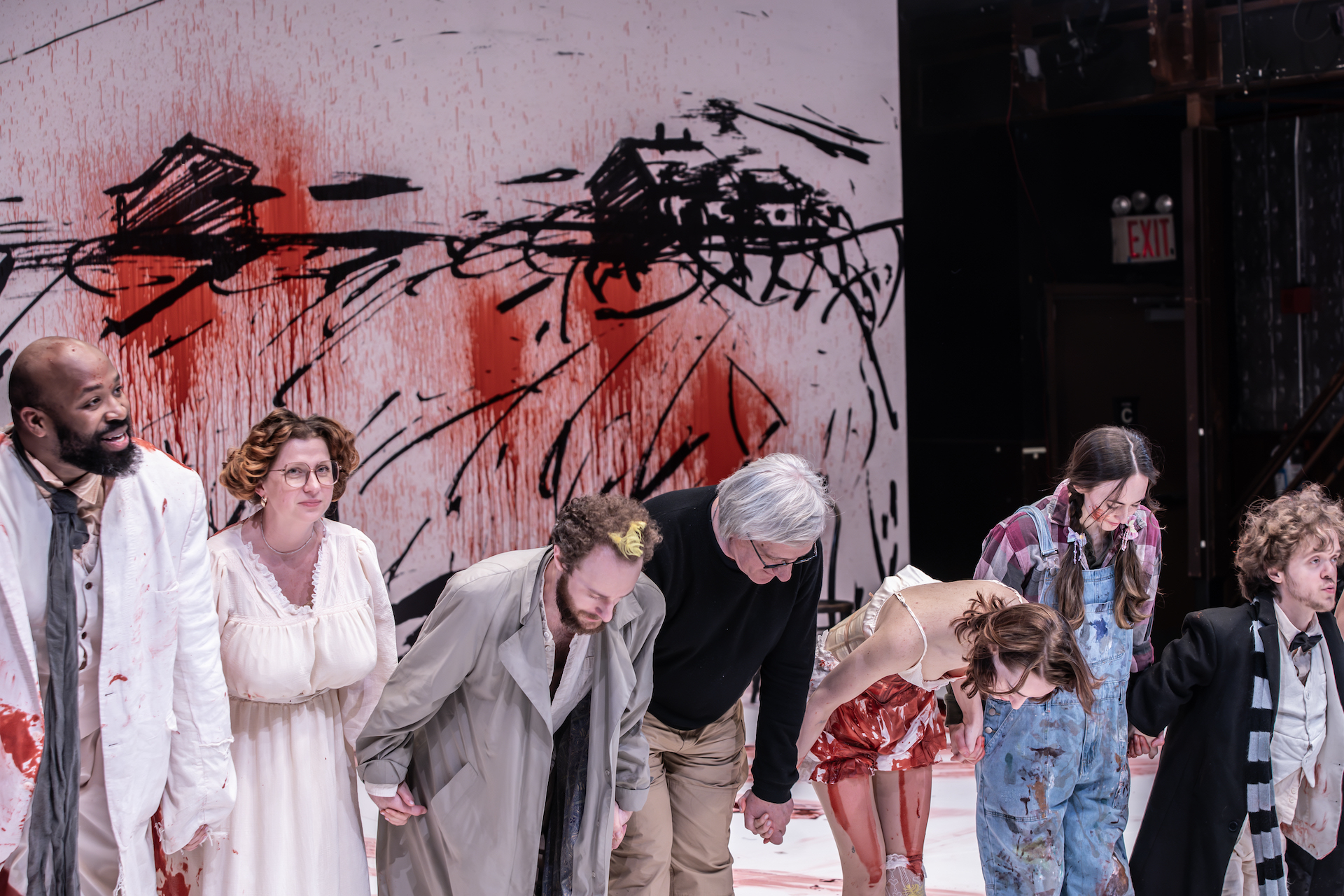
Uncle Vanya ends with Vanya and Sonya abandoned on the estate. But Krymov has radically changed this original ending, making it both more climatic and illustrative of contemporary horrors. Vanya’s mother—a stereotypical Jewish busybody—does not pity her son. Instead, she throws him a gun and begs him to shoot himself for having accomplished nothing in life. Having failed to become a doctor or a professor, he could at least become a fallen soldier—a hero. Her provocation for suicide, however, assumes an unforeseen turn as Vanya takes aim and shoots more than once. And, unlike in the original, he does not miss. All the sorrows, expectations, and frustrated desires of the cast, including the Professor himself, lie dead in pools of blood. The play’s black-and-white backdrop, which depicts a wheatfield—that quaint, innocent, provincial life from the past—is now soaked in red. With this new body count, Krymov invites his American audience, watching the play in New York in 2026, to make a painful connection between “scenes from a country life” elsewhere (in Putin’s Russia) and those of their own country, where the right to carry and mass shootings are a different kind of horror. And if that wasn't enough, Vanya’s bitterness, his futile longing for Yelena’s affection, all while in deference to his Jewish mother, also ring of the plight of an incel. The feminine world, in Vanya’s mind, must be punished for ignoring his needs, and since this “special military operation” has been officially sanctioned, why not add to the bloodshed.
The only person spared is Sonya, as pure and morally intact as in Chekhov’s original, still faithfully bound to her uncle Vanya. Despite the massacre, her final monologue—or sermon—remains unchanged:
We will rest! We’ll hear angels, we’ll see the sky studded with diamonds, we’ll see all earthly evil and suffering drown in mercy that will fill the world … Poor, poor Uncle Vanya, you’re crying… You haven’t known joy in your life, but just wait, Uncle Vanya, wait… We will rest… We will!5
Yet Sonya’s innocence is now soiled as she drags corpses off the stage, gasping for breath. Complicit, she cleans up and hides the mess. Moreover, in doing so, as the murderous Vanya falls apart, Sonya completes the act of violence—at first state-sponsored, then society-sponsored, and now, via Sonya, family-sponsored.
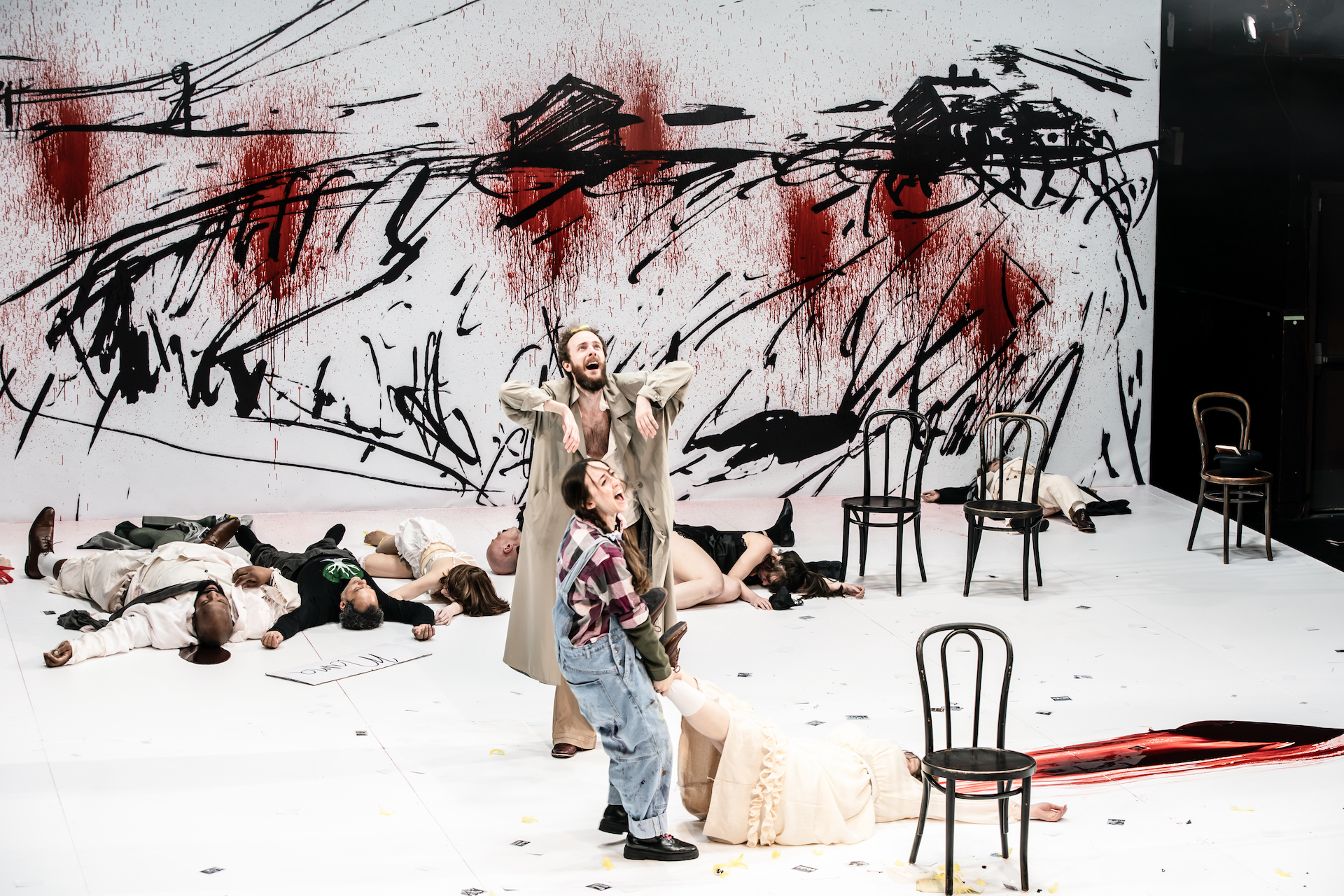
An artist in exile, Krymov walks a fine line. Looking back on his home country before and after its full-scale invasion of Ukraine, aware of his American audience, and certainly relying on his Russian-speaking audiences both in the U.S. and back home, whose intimate familiarity with Uncle Vanya he takes as a point of departure, Krymov paints scenes of his country’s life. He is filled with anguish, and maybe a sense of guilt, for the people and places he has been forced to abandon. His Sonya, too, is unable to bring herself to renounce her uncle. At the end of the show, the audience feels Vanya and Sonya’s pain. But whether the climax is truly a tragedy is not a straightforward question. Sonya runs off-stage with a scream of grief while Vanya stays standing. A murder of crows—the same ones who snatched all the little chicks—eclipses the sky. Sonya may have escaped the cycle of violence, but now Vanya must face it. As he starts apologizing profusely to the audience, darkness descends. As the audience is torn between joyous guffaws of disbelief and silent mourning, Krymov succeeds in bridging continents and historical eras.
-
 Dana Fishman
An undergraduate student at CUNY Hunter College currently completing their degree in Urban Studies. They are interested in pursuing a career in urban planning and public policy.
Sources
- 1 Daria Talanova, Sonya Richter, and Ksenia Storozheva. “Coming Home to Roost: How Veterans of the War in Ukraine Are Reshaping Russia’s Crime Statistics” // Novaya Gazeta Europe. February 3, 2026.
- 2 Rebecca Rommen. “Russian Soldiers Were Convicted of Over 100 Murders When They Returned Home Last Year, a Report Says.” // Business Insider. May 5, 2024.
- 3 Anton Chekhov. Five Plays. Translated by Marina Brodskaya. Stanford, CA: Stanford University Press, 2010. P. 122.
- 4 Anton Chekhov, op. cit., p. 134.
- 5 Anton Chekhov, op. cit., p. 160.