What happens when poets and musicians turn to AI—and is dialogue with an artificial voice possible? Listening to albums by TATAR KYZ:LAR and Roman Osminkin, Kathleen Mitchell-Fox explores how poetry, music, and AI intersect with multilingualism, cultural reclamation, decolonial politics, exile, and resistance to war.
When a 25-year-old Julia Kristeva moved from Bulgaria to Paris in 1966, she encountered a rapidly changing conceptual landscape: the old ways were over; phallogocentrism was finished; the protests of May 1968 were on the horizon. At this charged time and place, Kristeva found—however imperfectly and out of context—the works of side-lined Soviet thinker Mikhail Bakhtin.
Kristeva would never meet Bakhtin (and the finer points of her engagement with him have been argued extensively), but she took from him the idea of dialogism. Dialogism means never having the last word; it means encountering other uses, meanings, and voices within the words we speak.1 From dialogism, Bakhtin arrives at the idea of the polyphonic novel. His choice of musical metaphor is not incidental: “the dialogic word” (Bakhtin’s expression) contains multiple, coequal parts that sound together and, thus, create “polyphony” within the text. Words and music are linked through dialogue.
A year before Barthes would declare the author dead and Debord would proclaim society a spectacle, Kristeva concluded that “[m]ore than binarism, dialogism may well become the basis of our time’s intellectual structure.”2 It is a wild kind of optimism: the hope that the years to come would be defined by radical, never-ending dialogue, grounded in and animated by the certainty that we might all meet each other—be accountable for one another—inside the word.3
Certainly, as I sit on the U-Bahn in summer 2025, nearly 60 years after Kristeva read Bakhtin, I find myself hoping that the spirit of dialogism is alive and well. I am in Berlin to interview poets, because I want to write about poetry (a form that Bakhtin infamously and hastily disregarded). In preparation for my next interview, I'm listening to an album recently released by the poet I'm about to talk to. It’s exciting! I'm relieved that I won’t have to pretend to like it. Later, the poet tells me that the album was made using AI, and I feel myself pause, wondering if this means that I like it less now.
What can artificial intelligence (AI) do for poetry? The question itself stings. Poetry is creation (poeisis!); AI is hyped-up intellectual property theft and environmental destruction… apart from, as we’ve learned to say, in certain use-cases, medical applications, etc. I’d assumed that the relationship between poets—at least, real poets—and AI was one of animosity. Now I’m not so sure.
What I’m even less sure of is the role of dialogue in the creative process today. I don’t know if I can (un)reasonably hope that dialogism is the intellectual structure of our time. The very fact that I’m in Berlin talking to Russian-speaking poets might be an indication that “dialogue” is facing some significant obstacles. To me, AI seems like willful surrender, like an abdication from dialogue. You have left the chat. Interestingly, whereas music was Bakhtin’s metaphor for the dialogue between voices within words, today, music is where the tensions around dialogue in poetry are playing out and, for there to be dialogue around AI use and poetry, this music needs to be listened to. In what follows, I try to hold two extremes in tension—the statistically determined mechanisms of AI-generated content and the lively, dialogic thinking that inspired Kristeva to find not only social but revolutionary potential in text. Above all, I try to avoid overdetermining the dialogue. I can’t speak for these albums or the poets who made them, but I can try to share the impressions their music made on me and to give a sense of what I think they might tell us today about the thorny intersections of politics, poetry, and technology.
Contexts/concepts
The albums under discussion are AŞ (2025), an electropunk, multilingual reclamation of traditional Tatar culture, by TATAR KYZ:LAR (poet Dinara Rasuleva and musician allapopp), and Life is Pain (2026), a kitschy critique of dominant Russian discourses of hypermilitarism and their devastating effects, by Roman Osminkin. I first met these poets in summer 2025 and started writing about their albums in summer 2026. Both TATAR KYZ:LAR and Osminkin openly flag their use of AI. Specifically, they use AI in the transformation—or, better, transposition—of their poetry into music albums. AI enables the movement of poetry from text to song, thus “producing” these albums.
The degree of AI usage in these albums differs hugely: AŞ features a single component—a “choir”—produced by an AI plug-in, meticulously trained on a manually selected dataset; Life is Pain uses AI to generate simulated tracks, instrumentation and vocals. There is also a contrast in these albums’ contexts of production: although Rasuleva, allapopp, and Osminkin all emigrated from Russia to Germany, their stories of emigration are quite different. What connects the albums is that they involve AI in projects motivated by political concerns. While AI is frequently associated with needless “slop,” these poets use AI to generate musical elements for texts that have a striking urgency—even a necessity—to them. In these albums, AI as an “instrument” is implicated in leftist and decolonial artistic agendas, focused on the most fraught questions of post-socialist identity (and Russian culture’s position within it). AŞ and Life is Pain make me wonder what has changed and what is changing about poetry, not only in Russophone culture since the start of Russia’s full-scale invasion of Ukraine in 2022, but also in an AI-ascendant online world, and how these issues might interact.
Of course, like any tool, generative AI can both expand and restrict the user’s creative freedom. Yet, the argument that cars, guns, roller-skates, the internet, and clarinets are only as safe, or as good, as their wielders, might not be that useful here. These are great poets and artists. What I’m interested in is why AI appeals to them and what it is doing for them. Using AI to produce sounds or songs might seem like a magic trick (pulling a musical rabbit out of an AI hat), but it becomes less elusive if we engage with the medium that many AI interfaces simulate: dialogue.
We are encouraged to treat the interfaces of large language models (LLMs) (“assistants,” “chatbots”) as entities capable of chatting with users. For best results, we are encouraged to address the bot as “you,” to give commands, to be polite, and to mirror the bot’s code-informed syntax of “do/don’t” binaries. Yet, for all this, we know that “talking” to a chatbot is not a dialogue: an interface cannot “chat.” If “chatter” often denotes (misogynistic) ideas of “meaningless talk,” then the meaninglessness generated by a chatbot lacks the compensatory warmth associated with “chatting.” “Responses” are the result of an intense and rapid-working re-combinatorial mechanism (the LLM’s syntagm) applied to an incredibly dense dataset (its paradigm). This is how “theory-free inference” works: by inferring statistically probable outcomes (correlation) without understanding why (cause). The chatbot generates the appearance of communication, but what it “communicates” is statistically overdetermined. There can be no dialogue here. What LLMs produce are quotations that come from everywhere and nowhere. At the same time, it is important to stress that not all AI use is use of an LLM (AŞ was not made using an LLM), but by framing AI through dialogue, communication, and quotation, it becomes easier (for me, at least) to parse its relationship to the creative arts.
After all, quotation is also at stake in the dialogic word. After reading Bakhtin, Kristeva begins to think that “any text is constructed as a mosaic of quotations; any text is the absorption and transformation of another.”4 She presents a vision of text as enlivened—always open to other influences (absorption), always in process (transformation) and never free from embodied experience. As a result, she begins to understand text as analogous to revolution because “the one brings about in the subject what the other introduces into society.”5 As I get into these albums in more detail, I reflect on what they introduced me to and the kinds of experiences (if not revolutions) that they make possible.
Polyphonies of the lost and found
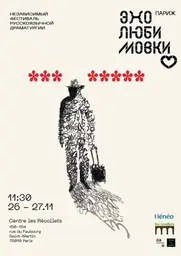
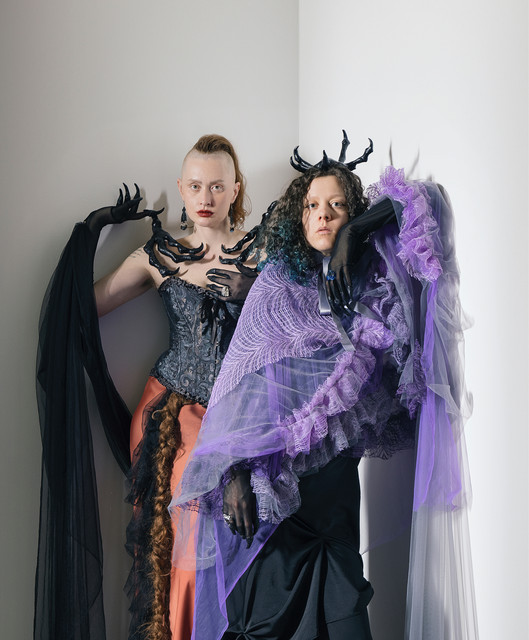
In March 2025, TATAR KYZ:LAR (“TATAR GIRL:GROUP,” 2020–) released their debut album AŞ. TATAR KYZ:LAR is a Berlin-based collaboration between the poet Dinara Rasuleva and the musician allapoppIn this text, there are many instances of what might be considered non-standard capitalization relating to the names of people, places and songs. Given that it might be distracting to mark each instance “[sic],” the editors have decided that it would be better to include a note to this effect. . An electropunk odyssey through questions of language, identity, and home, AŞ is so named for traditional gatherings of friends and family in Tatar households to mark rites of passage (aş). TATAR KYZ:LAR have been in collaboration for six years, and this is their first album: it is a labor of love, a feat of musico-poetic engineering and some funding from the German Commission for Media and Culture. AŞ is the flagship for the group’s decolonial agenda in artistic practice operating across multiple languages (German, English, Russian, and Tatar), and features tracks not only with Belarusian singer Sveta Ben’ and popular Tatar-language singer, Aigel Gaisina, but also an AI-generated “Tatar Virtual Choir” after which the album’s first track is titled.
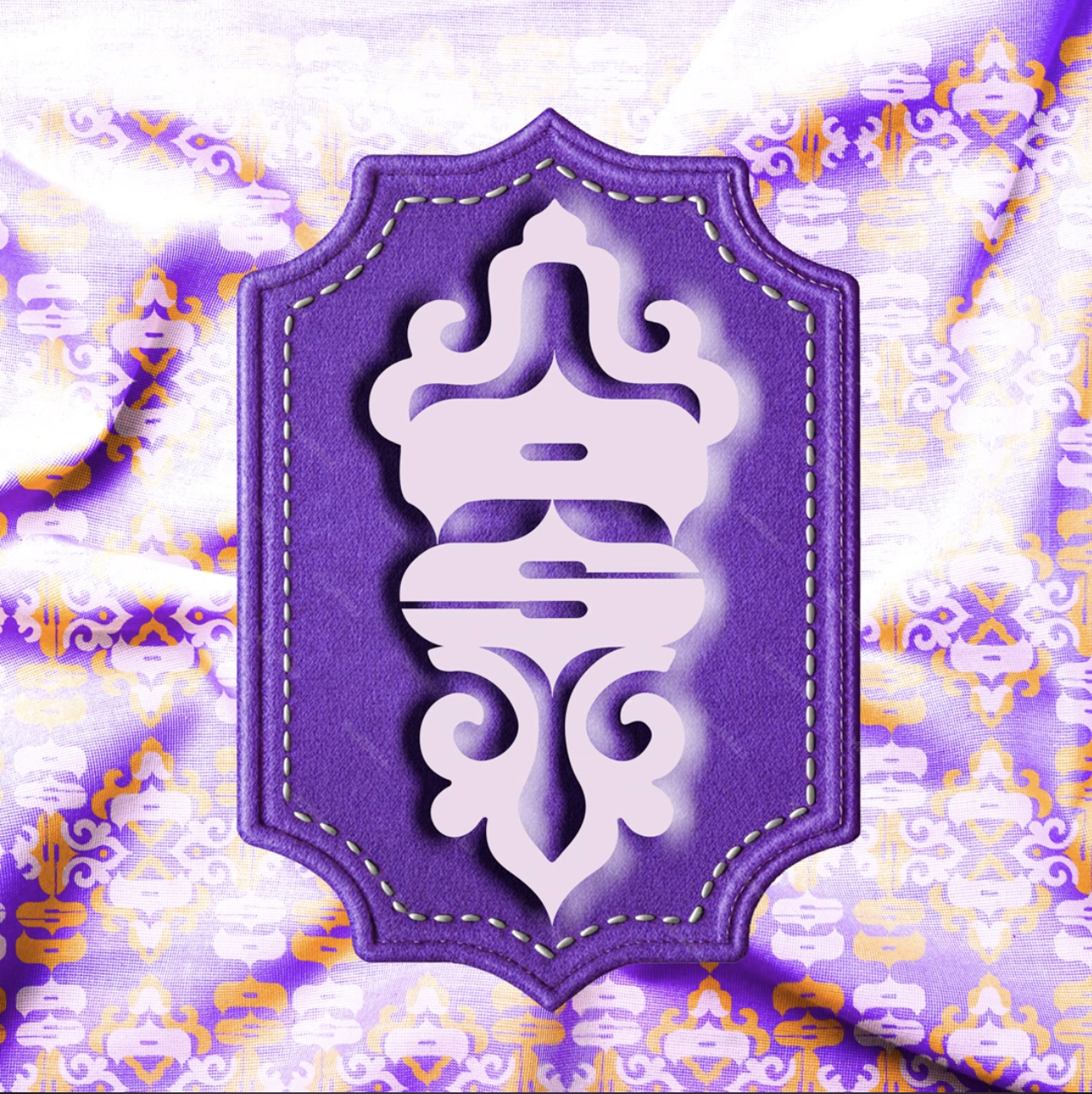
AŞ comes in multiple formats: a Spotify album, a cassette tape, a printed zine with annotations, and an online experience. 11 tracks and 40 minutes long, AŞ leads the listener through a sound-world dominated by insistent synth beats, manipulated glitching, vocals that hover between sung and spoken word, and electronic instrumentation that occasionally has speechlike rhythms but is not speech. The album is accompanied by predominantly English-language promotional materials, inviting a wide audience both in Berlin and online.
In their own words, TATAR KYZ:LAR “seek to reclaim their stolen culture and language while integrating it with their immigrant and queer experiences.”6 The suppression of Tatar culture within the Russian Federation (and its various imperial predecessors) meant that, as an adult, Rasuleva realized that she had essentially un-learned her native Tatar language. The process of its re-learning is presented in the album’s lyrics (as well as in Rasuleva’s first prose work of fiction, Traumagotchi (shell(f), 2025), and her translingual poetry collection, Lostlingual (Rab-Rab Press, 2025)). After beginning her career in slam poetry in Kazan, Rasuleva moved to Berlin in 2015, where she has become a notable poet and literary activist, responsible for organizing TEL:L, a writing lab dedicated to the collective experience of “writing in one’s native, forgotten, or stolen language” and “multilingual writing.”7 When I spoke to Rasuleva, she emphasized the significance of her decision to reclaim her mother tongue in poetry: whereas she saw her prior poetry (written almost exclusively in Russian) as having a more confessional, even “monolithic” quality, she thought of her new and more linguistically experimental poetry as more heterogeneous, fragmentary, and, she added, musical.8
Tensions between a lost heritage and its imperfect recuperation are at stake throughout the album. Aş is a tradition, but TATAR KYZ:LAR acknowledge that they do not exist within the geographies or identities in which this tradition is rooted. They’re a self-consciously immigrant, queer, feminist collaboration, and what they undertake here is not a restoration but a reinterpretation.
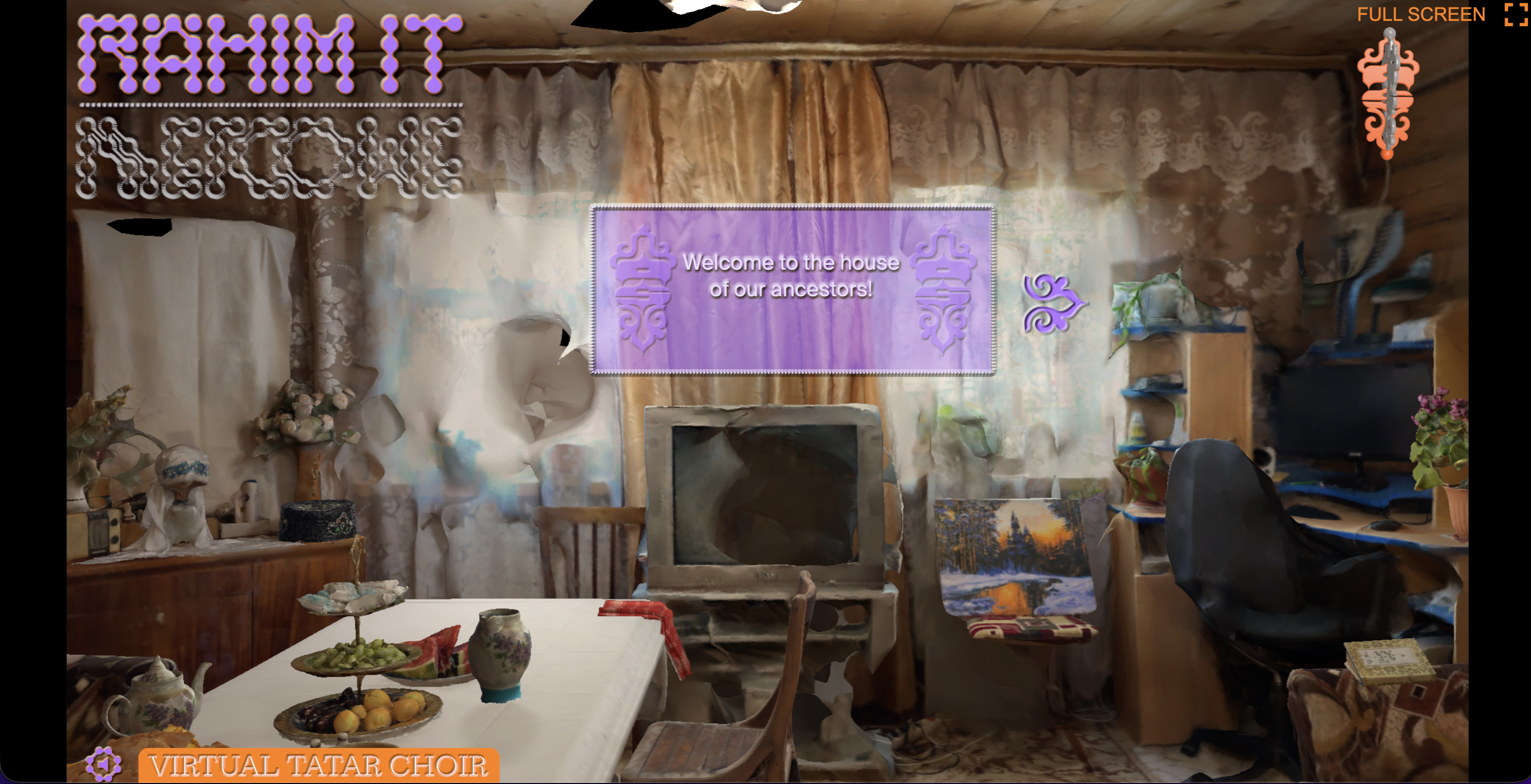
Part of this imperfectly recovered heritage is processed through the AI Virtual Tatar Choir, showcased in the first, wordless track, “Virtual Tatar Choir—Ay bılbılım” (“Ay bılbılım” is the name of a Tatar and Bashkir folksong; “Oh, my nightingale” in English). Not only would a “real” Tatar choir potentially be hard to come by in Berlin, but the “virtual choir” makes audible the technical work that has gone into the reclamation (and recreation) of this heritage. The track sounds neither like the well-known and often re-recorded folksong nor the ethereal sounds of a Tatar choir. The closest comparison I can think of is the soaring/sawing noise made when a song is played backwards; it’s as if the “choir” is constantly catching up with itself. There’s something intentionally alien about the sound. The track is also used as the background music to the online experience, in which the player is welcomed into a composite Tatar home to participate in aş.9 These sounds score the album’s unhomely home, the center of the listening (and playing) experience. Almost cyborg-like, this stark, synth homecoming invites listeners into its strangeness.
The Virtual Tatar Choir is not the product of an LLM, but Neutone, a “realtime tone-morphing plugin” that uses a specialized type of machine learning to transfer the timbre of one sound or instrument onto another.10 Discussing the project, allapopp makes it clear that using Neutone enabled TATAR KYZ:LAR to take every precaution against the prejudices commonly encoded in many LLMs (as a result of bias in their datasets).11 TATAR KYZ:LAR even advertise the availability of the choir’s training data online.12 What does this “timbre transfer” sound like? Whereas a real choir contains the potential for polyphony between multiple, co-equal sung parts, the Virtual Tatar Choir has no identifiable “parts” or “voices.” It is synthetic, both in musical timbre and in the most literal sense—it is a non-organic composite. To put this in the language of communication and quotation I was using earlier, it is not that AI is producing the data for the choir, but that it is reproducing it in other (alien) voices. These voices-that-are-not-voices establish the backdrop against which the listener encounters the humans of the album, constructing the sound-world that Rasuleva, allapopp, and their collaborators come to inhabit.
Highlights from the rest of the album include “Bury,” which pairs a driving beat with Rasuleva’s trademark quasi-rap, slam-poetry expressivity to narrate the searing excision of Russian-ness from the non-Russian body: “cut the russia from you.” The track “Omon” is a bleakly witty riff on the Matthew “begat” verses from the New Testament (“Abraham begat Isaac; and Isaac begat Jacob; and Jacob begat Judas […]” (Matthew 1:2–17)), which uses the phonic similarity between the Biblical Amon and the name of Russian law enforcement agency OMON to kill off Christ’s genealogy.
If the album has a single—or, indeed, a manifesto—it is “Közge” (“The Mirror”), TATAR KYZ:LAR’s collaboration with Aigel Gaisina. This is multilingual sound play at its finest. Here, the sparse synth-scape is penetrated by the eerie melody of Gaisina’s wavering soprano, which contrasts strongly to Rasuleva’s spoken word, while drawing allapopp’s backing vocals to the fore. The dynamic interplay between vocals is heightened by the music video, which features Rasuleva and allapopp lip-synching to all three parts. As Rasuleva points out in the zine, the lyrics develop from a simple wordplay between qara küz (“black eyes”) and küzga qara (“look in the eyes”) in Tatar.13 The repeated qap-qara (Tatar for “bleak-black”) is punctuated by the higher pitched, more articulated kap sound (onomatopoeia in Russian for “drip”). The meanings of both phrases converge in the music video when allapopp’s eyes drip black.14 In the vocals, the persistent alternation between Tatar qap and Russian kap draws the listener’s attention to the subtle difference in vowel sound and consonant articulation, especially as the instrumentation thins toward the end of the song. If you were unable to hear the difference between Tatar and Russian when you started listening, by the end you can sense it. How this new linguistic and sonic sensation for language should translate into feelings, however, is left open: Rasuleva notes in her album annotations, “[while writing the poem] I thought of darkness-blackness (repressions, despair, pain, death) and brave people resisting it, or living inside it, still keeping their internal light. Or not.”15
AŞ is marked by an invitation to imagine sharing what cannot currently be shared—a play with polyphony that does not exist and the sensations of translingual sound play. AŞ is defined by a persistence that is not wholly optimistic but is strikingly resilient. The album’s final track “Zamova,” featuring Sveta Ben’, has an incantatory quality, a vital and rhythmic persistence, palpable even before a Google search can reveal that the song’s title means “spell” in Belarusian. The song concludes with the chant “no one dies” (in Belarusian, «нiкто не помiрае»), not a refutation of reality but, perhaps, a counter-imagination of it.
Puppeteering the performer
In late December 2025, leftist, Leipzig-based poet Roman Osminkin announced on Telegram his forthcoming album, Life is Pain. The album presents texts written by Osminkin set to AI-generated music and “performed” by singer-cipher Marionetochka (2025–). The album was released track by track to YouTube over a number of weeks starting in January 2026, and, in May of the same year, Osminkin announced the album’s availability on SoundCloud with bonus tracks. Life is Pain is a continuation of Osminkin’s previously established post-ironic persona as a poet, now stripped of his own performances and deployed to markedly more morbid ends, as he reflects on the horrors of Russia’s war in Ukraine, Russian hypermilitary culture, and his own life in emigration/exile in Germany.
As the titular meme reference suggests, Osminkin/Marionetochka’s Life is Pain is less an album than a pastiche of one, the point of which is not the songs but the exercise itself. Its catchy kitsch melodies and painfully on-point lyrics are best listened to from this point of view. There are 15 songs (not including bonus tracks); each is one- to two-minutes long and accompanied by “slop-style” black and white AI album art depicting dreary scenes of puppets, ballet dancers, and men and children situated amongst wartime destruction and urban ruins.16
For the past two decades, Osminkin has been among the most prominent voices in Russophone politically engaged poetry and has produced some of its most memorable performances. A remarkably plastic performer, he takes on multiple personas on the page, on stage, and online, shifting lightly between the roles of gopnik, political activist, intellectual, and cringe-inducing rapper.
Long-time fans may be surprised that, apart from the lyrics, every aspect of Life is Pain is AI-generated. Previously, Osminkin was a member of musical collaborations with other humans, like Technopoetry with Dasha Che, Anton Komandirov, Marina Shamova, and Anastasia Veprev (2012—с. 2021), and many of his poems are best known as songs (for instance, “Communism Is Not an Ideal” (2013)). Born and raised in St. Petersburg (Leningrad), Osminkin got involved with slam poetry, poetic actionism, and politically engaged performance practices in the late 2000s and 2010s. He left Russia in the fall of 2022, when his position there became precarious. Because of the circumstances of his emigration, there are obvious ways in which Osminkin’s opportunities for time- and resource-intensive musical collaboration are limited. But to me, Osminkin’s AI-undertaking speaks not only to the difficulties of producing a “real” album in emigration but also to his shifting perspective on his own role as performer.
When I first spoke to Osminkin six months before he announced the album release, he was profoundly aware of his own position as a Petersburg poet outside of Petersburg, as well as the attention he’d garnered from academics in the West. He quietly remarked to me that he did not want to perform, nor could he see the opportunity for it coming up any time soon.17 At the very least, by adopting Marionetochka as singer-cipher, he’s chosen to step out of the spotlight of his own poetry. He writes that—song lyrics aside—“the rest [of the album] was taken care of by the time and place, wherever our biosocial bodies are flung and may yet be flung.”18 This does not mean that there’s nothing “performative” in Life is Pain, however.
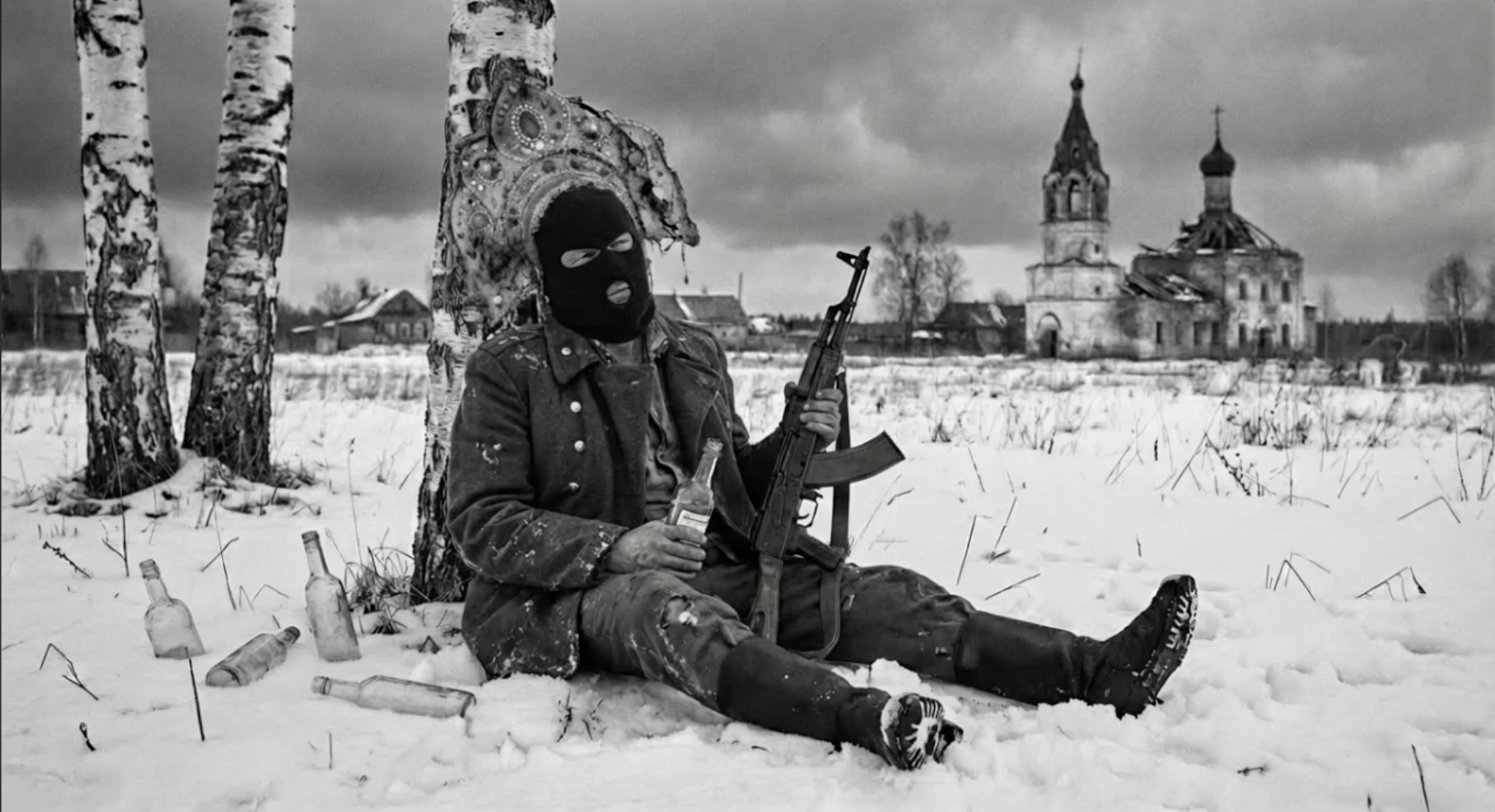
Life is Pain is a performance that attempts to minimize the visibility (and audibility) of the performer. This might sound perverse. The singer-cipher’s name (Marionetochka, “little marionette”) is, after all, a pun on the stage name of the Russian popstar Monetochka (“little coin”), and the YouTube description for each track begins, “this is ai-artist marionetochka.” The human singer Monetochka is famous for a breathy soprano (“heady”) voice and naïve delivery. This vocal quality is present on some tracks (such as “the boys are off to war,” “hegemonically masculine,” “aty-baty soldiers were going”). It’s totally absent on others, replaced by a piping, nasal voice; a “belting” chest voice; and a much more masculine-sounding tenor (listen to “unfathomable russian soul,” “the shadow of cynicism fell,” “when the troops went off to afghanistan i[,] clamoring[,] climbed out of mom,” respectively). In other words, the percentage of “Monetochka” present in Marionetochka varies. What’s more, the variety of gendered and embodied associations evoked by these AI-simulated voices makes it evident that they have no one stable “source” in reality. “Marionetochka” is not a cipher for a particular singer, but rather for an AI-facilitated practice of appropriating multiple, different voices.
The music likewise operates across a broad spectrum of genres, most prevalently a hybrid of music-box melodies and “Russian folk,” intercut with what can only be called “chill lo-fi beats.” The hip-hop infusions and occasionally rap-adjacent vocals are the most direct reference to Monetochka, although the twinkling music box chimes and stripped back piano parts might also remind some listeners of the deliberately childish quality of her music (but not necessarily the music itself).
The “Russian” musical references here are as hacky and stereotypical as it gets: duple-time oompah-sounding ostinatos, bellyaching accordion sounds and major-minor tonal mutability. Incidentally, all these traits are reminders that what sounds stereotypically “Slavic” owes a lot to Klezmer and Romani musical traditions. Perhaps with an eye to the problematic definition of “Russian folk” music, Osminkin describes Life is Pain as “neuro-folk music.”19 Homogenizing nationalist fantasies about “the folk” from the nineteenth century are, thus, reproduced through the tech “hive-mind” of AI, which chews up and spits back out the most statistically likely combination of characteristics. Here, the blunt stereotypes are simply updated with lo-fi beats and pop vocals.
Osminkin’s lyrics bear his trademark post-irony, but here the tension between sincerity and insincerity is more strongly felt than ever. The chorus to one song goes: “it’s dancing on bones / it’s corpses in the news / it’s mediatickling / to the point of hiccup-amnesia.” Osminkin allows himself heavy doses of darkness. The description for one song endearingly casts his listeners as “my dear devourers of other people’s suffering.”
Life is Pain is preoccupied with childishness on multiple levels. Osminkin not only exaggerates nationalist rhetoric (“motherland” becomes “russian womb”), but also adopts a condescending parental tone (“come on, eat some falafel,” “you don’t feel like snuffing it? | what’s that? not really?”). Through the combination of morbid imagery and nursery-room registers, Osminkin evokes a well-known trope: the corruption of childlike innocence. This tension comes to a head in what’s currently the last track released on YouTube, “boys and girls and their molesters too” (a twist on the theme tune for the children’s TV show Eralash (1974–), “Little boys and little girls! And their parents too!”). This is one of the only tracks not accompanied by AI album art (besides this, “when the troops…” is paired with a real photograph of Osminkin’s Petersburg Writers’ Union ticket). Instead, the song’s lo-fi music-box beat is paired with (I assume) real footage of teenage children in military uniform racing to dis-/re-assemble rifles in a windowless room with slogans like “TO LIVE IS TO SERVE THE MOTHERLAND” stencilled on the ceiling girders. The viewer is left to draw their own conclusions.
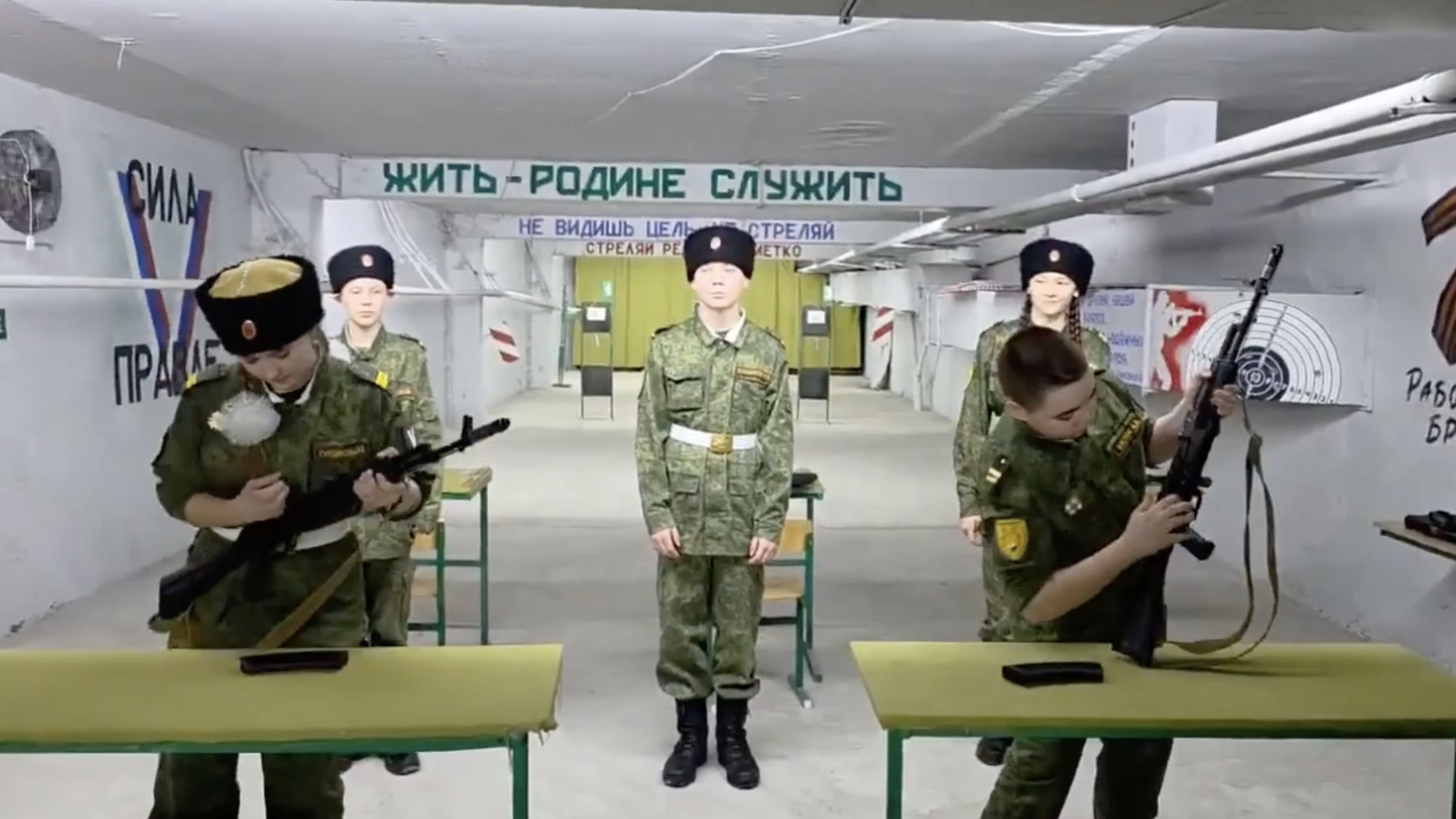
The overt childishness—in lyrics, in simulated instrumentation, and in vocal effects—grates. But Life is Pain is not designed to be enjoyed or to “move” listeners. Unlike AŞ, it’s not a sound-world in which anyone should make themselves feel at home and, yet, it is terrifyingly homey. Every element of these songs is familiar from somewhere, but they come from nowhere. Life is Pain is an exercise in alienation, which feels all too familiar. It plays with the redaction (and, then, over-population) of the performer’s voice in a way that is never quite devastatingly funny and almost devastating.
Invitation to a dialogue?
As I wrap up my thoughts on these albums in fall 2026—nine months after Osminkin announced Life is Pain and 18 months after the release of AŞ—I’m struck by how quickly AI and the attitudes toward it are changing. I wrote these reviews before the possibility of an AI-apocalypse had become a mainstream news item. On the U-Bahn last summer, I couldn’t have imagined the urgency with which these kinds of existential questions are now being discussed. My interest in these albums has always been far more “small-h” human. For me, AŞ and Life is Pain illuminate acute social concerns at the heart of what might seem like a solitary experience (emigration) and a solitary activity (writing poetry). The fact that both Rasuleva and Osminkin have explored their poetry as music suggests a desire to reach different audiences and to connect on a level that is not purely verbal. Collaboration is a cause for optimism: Rasuleva works with allapopp and Osminkin has voiced hopes to “bring the AI-singer-cipher to life” with the help of flesh-and-blood musicians.20 On both accounts, their albums have pushed me to go beyond my interest in their poetry and to reflect—with less certainty and more enthusiasm—on what it means to create, collaborate, and share.
Part of my listening to these albums has been listening with other people, whether at full volume in the student lounge, on the projector in a lecture, or at the Reading 21 workshop. Everyone’s had their take: this music is great for dancing, terrible for karaoke; this poetry is fashionable (bad!); this poetry is fashionable (good!); this album’s the quintessence of kitsch; that album distills the “aura” of art after the age of mechanical reproduction; AI could be a strategic tool for Moscow Conceptualist discursive critique!... The breadth of vigorous responses stands as testament to these albums’ strengths and the range of interpretations to which they could lead. For the sake of remaining in a more speculative mode, I want to return to Bakhtin and Kristeva. Bakhtin’s dialogic word offers the opportunity for encounter with other ideas, thoughts, and voices within the word; Kristeva treats that opportunity as not just innately social but as potentially revolutionary. What encounters do these albums invite and what potentials might they harbor?
More than anything, AŞ and Life is Pain are albums dealing with loss—loss of a culture, a language, a home. Whether they speak to a suppressed traditional Tatar culture or an alienated contemporary Russian one, these albums treat the transposition from text to music through AI as an opportunity to negotiate something that cannot be recuperated, and to ask who or what we might encounter along the way. The voices-not-voices of the Virtual Tatar Choir’s polyphony and the multiple “voices” of Marionetochka are inanimate sound-objects, which might be cherished, reviled, or fetishized but are ultimately invested with these profound losses. Losses that might be shared, mourned, and processed with other (human) subjects.
My level of scepticism about AI—the doom that I worry it harbingers for dialogue—is, in some ways, redoubled by the anxieties expressed in these albums, as they address the most pressing political concerns facing the Russophone world today. While Kristeva’s voluntary emigration led her to Bakhtinian dialogism, the pressure to emigrate faced by a writer like Osminkin has changed and challenged how he performs poetry; it seems to make dialogue of any variety difficult (if not painful), but, for that, all the more necessary. The reworked polyphony at the core of AŞ creates the space in which TATAR KYZ:LAR’s voices come to play both poetically and musically; it offers a counter-imagination of the future grounded in a reclaimed and reinterpreted past that falls prey to neither sentimentality nor technological utopianism. In both AŞ and Life is Pain, AI is not so much a “gimmick” but a prompt and a provocation. Tentatively, I wonder if this is what “ethical” AI use in the arts could look (or sound) like—not just an invitation but a challenge to engage in dialogue, in spite of it all.
-
 Kathleen Mitchell-Fox
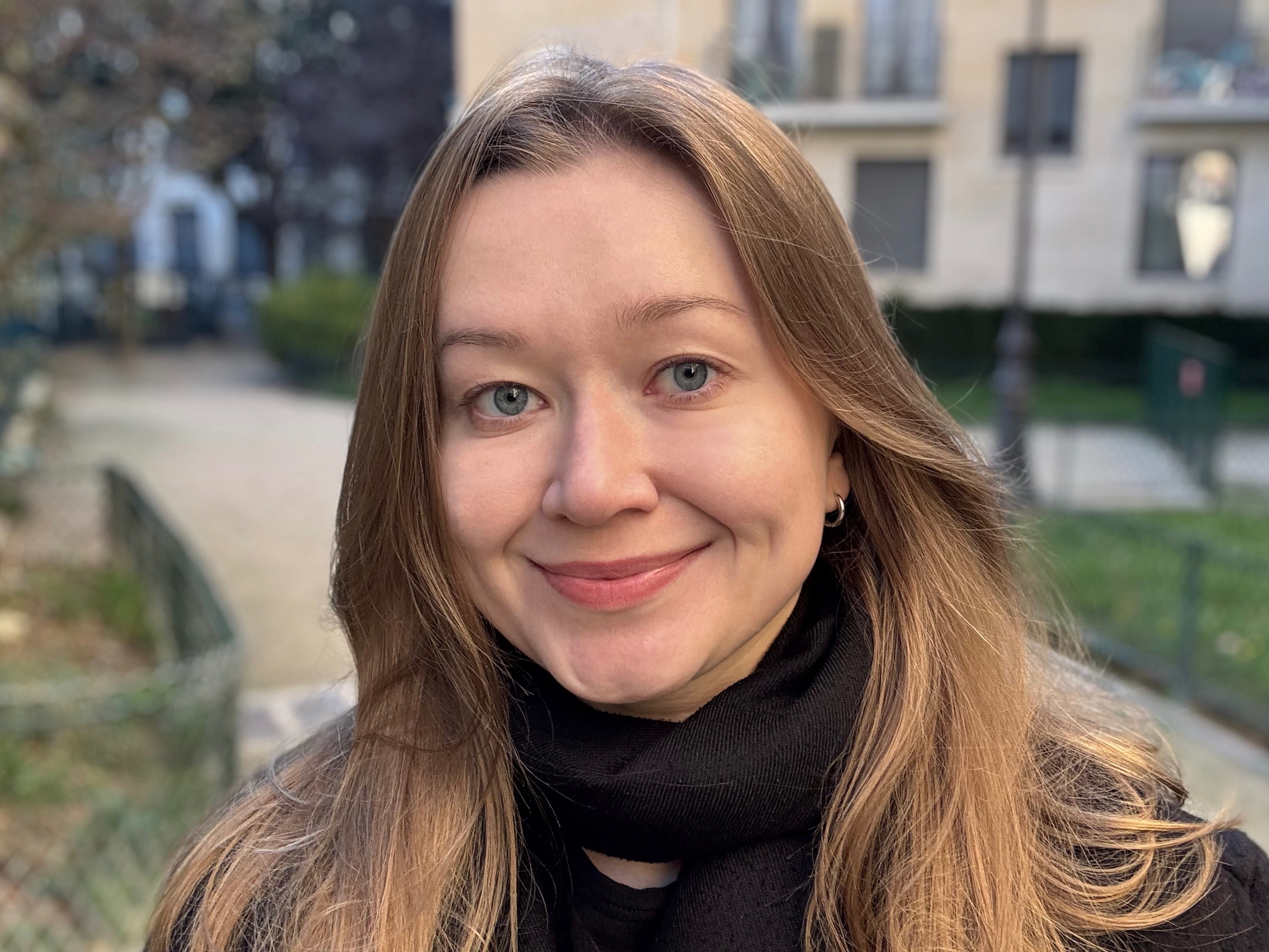
A PhD candidate in the Department of Slavic Languages and Literatures at Princeton University. Her dissertation research focuses on twentieth- and twenty-first-century Russophone poetry and literary theory, exploring the concept of “voice,” ideas of poetic performance, and the intersections (staged or refuted) between aesthetics and politics. She has published work on the poetry of Joseph Brodsky and Varvara Nedeoglo.
Sources
- 1 Mikhail Bakhtin. Problems of Dostoevsky’s Poetics. Edited and translated by Caryl Emerson. Minneapolis: University of Minnesota Press, 1984.
- 2 Julia Kristeva. “Word, Dialogue and Novel” (1967). The Kristeva Reader. Edited by Toril Moi. Columbia University Press, 1986, p. 59.
- 3 All thoughts and utterances might be a “rejoinder in an unfinalized dialogue” (original emphasis). See Mikhail Bakhtin, op. cit., p. 32.
- 4 Julia Kristeva. “Word, Dialogue and Novel,” p. 37.
-
5
Julia Kristeva. Revolution in Poetic Language. Translated by Margaret Waller. New York: Columbia University Press, 1984.
- 6 allapopp and Dinara Rasuleva, AŞ, TATAR KYZ:LAR, March 28, 2025, bandcamp.
- 7 “tel.l.labs,” Instagram.
- 8 Dinara Rasuleva, in discussion with the author, July 2025.
- 9 The AŞ virtual ceremony can still be experienced online. Screenshot from the “online ritual” copied from “TATAR KYZ:LAR (allapopp & Dinara Rasuleva). AŞ—the Online Ritual,” HAU.
- 10 Rubric from Neutone.ai website. Neutone.
- 11 “allapopp,” on Neutone website. Neutone.
- 12 According to the zine, the “Virtual Tatar Choir” and the data on which it was trained can be viewed here: https://tatar-ash.space/tatarchoirdata. AŞ (zine) (designed by Teresa Schönherr). Berlin (self-published). 2025. 4
- 13 Dinara Rasuleva, “Közge,” in AŞ (zine). P. 31.
- 14 “TATAR KYZ:LAR, feat. Aigel Gaisina (AIGEL) – Közge / The mirror.” October 6, 2025. Directed by Petya Kibedova. YouTube.
- 15 Dinara Rasuleva, “Közge,” p. 34.
-
16
All the screenshots of “cover art” for Life is Pain are taken from Osminkin’s YouTube channel, “Roman Osminkin,” YouTube. [accessed April 20, 2026]. The SoundCloud profile and cover picture for Marionetochka can be found on the website. “MARIONETOCHKA,” SoundCloud.
- 17 Roman Osminkin, in discussion with the author, July 2025. See accounts of Osminkin’s poetry by Marijeta Bozovic in Avant-Garde Post-: Radical Poetics After the Soviet Union. Cambridge, MA; London, 2023; Mark Lipovetsky, “Between Prigov and LEF: Roman Osminkin’s Performative Aesthetics,” in Novoe literaturnoe obozrenie, No. 145. 2017; Joan Brooks, introduction to Roman Osminkin’s poetry collection in English translation, Not a Word about Politics! Cicada Press, New York, 2016.
- 18 Roman Osminkin. Post to channel “Os(’)minkin_pishushchii,” Telegram, January 25, 2026.
- 19 Roman Osminkin. Post to channel “Os(’)minkin_pishushchii,” Telegram, January 25, 2026.
- 20 Roman Osminkin. Email to the author, July 10, 2026.