In Showcase, we highlight noteworthy titles recently published in tamizdat. In our first issue, Lev Oborin reviews 15 books, including novels by Leonid Bershidsky, Dmitry Bykov, and Anya Makeeva, poetry by Aleksandr Del’finov, a collection of historical studies devoted to the future, and an anthology that conceptualizes the loss of home.
-
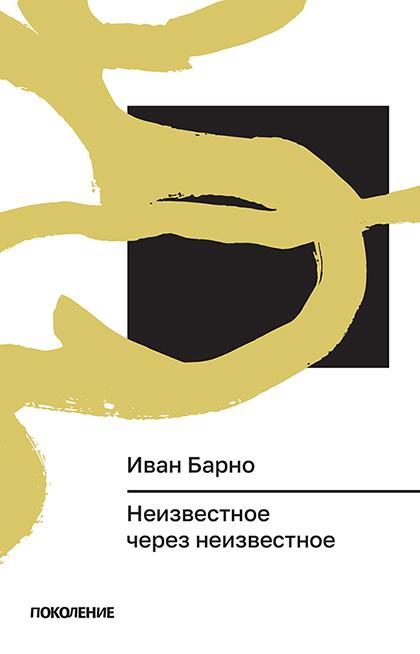 Neizvestnoe cherez neizvestnoe (The Unknown Through the Unknown)Literature Without Borders, 2026
Ivan Barno
This is a debut poetry collection by a poet who lives in Crimea and writes in Russian and Ukrainian. In Barno’s poems, diglossia is problematized (“once in primary school I wrote the word ‘серце’ [‘heart’ in Ukrainian] with a ‘д’—the teacher asked my mother if I knew the language which I was speaking—she could not come up with an answer”), employed consistently (a poem may begin in Russian and end in Ukrainian), and woven into the lyric narrative. The title, The Unknown Through the Unknown, is a formula for reflecting on and describing love. It turns a seemingly impassable language barrier into a space of passage and connection. “we kissed— / exchanged speech, / explored / past loves, negotiated a passage, / the search for a common language: / the anticipation of a spoken word, the memory of / a spoken word, finally, / the utterance of a word.” The love experience is a new, “unknown” one every time, even if there are “past loves.” Words and categories that didn’t previously come into contact with one another are now drawn to one another like lovers. Barno’s preference for long lines makes his texts almost prose poems or essays in which the erotic discourse gently transforms into the political one—with remarkable wit, at that: “licentious hands form a fortress—a lust for protection from the imperial crown: making a move on someone else’s member is colonization itself.” However, occasionally Barno shifts to a more analytical writing, possibly inspired by Arkadii Dragomoshchenko and Denis Larionov. He also demonstrates a penchant for unconventional quasi-aphorisms.
-
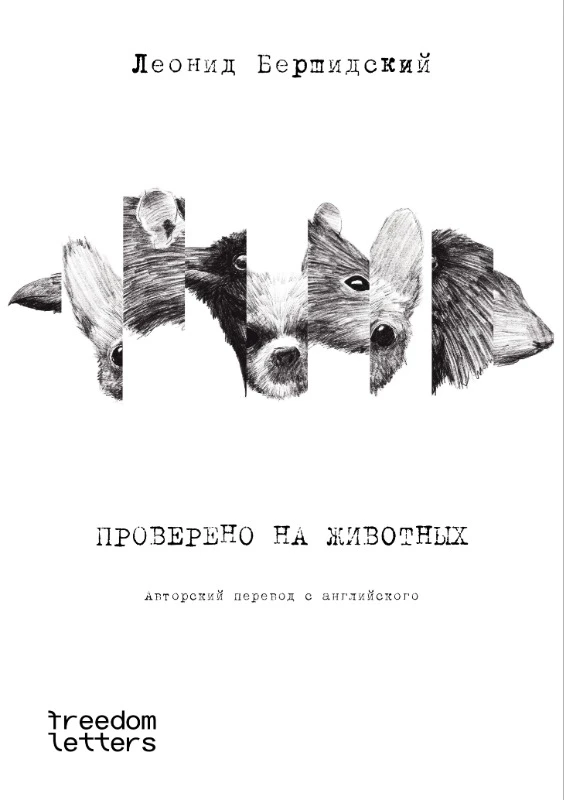 Provereno na zhivotnykh (Tested on Animals)Freedom Letters, 2026
Leonid Bershidsky
Leonid Bershidsky’s novel draws on multiple memes of recent years, from memories of Covid to the popular but unrealistic scenarios in which civic solidarity brings about beneficial change. Bershidsky uses many stock tropes of dystopian fiction: some seem to come straight out of Black Mirror. The novel weaves together three plotlines, labelled “Crows,” “Rats,” and “Dogs”. In the first, a Russian authoritarian ruler, who naturally bears a strong resemblance to a certain real person, is threatened by birds and paranoically links them to enemy sabotage; in the second, a researcher discovers the scope of suffering endured by laboratory animals and becomes a resistance leader; in the third—the least compelling—a top manager at an all-powerful German IT company, tasked with overseeing everyone’s happiness and obedience, realizes that he’s engaged in something very wrong. The latter two stories make interesting reading against the backdrop of real news about employees resigning from their AI company so as not to be complicit in the destruction of humanity. Bershidsky’s twist is to try to make this dystopia into a utopia—but one of the protagonists prevents this from happening. Perhaps it’s not even necessary to read the novel to guess which plotline—that is, which country and which political reality—will spoil humanity’s celebration of empathy and solidarity.
-
 Chernaia rechka (Black River)Freedom Letters, 2026
Dmitry Bykov
As Dmitry Bykov notes, classic Russian literature has encountered the Black River three times. There is Chernaya Rechka—the Black River—in St. Petersburg, on whose ice Pushkin fought in his deadly duel. Then, there is Valerik (the “River of Death” in Chechen), where Lermontov fought in battle. Finally, there is the river Chernaya (Black) in Crimea—an unfortunate battle there inspired Leo Tolstoy’s only significant poem. In Bykov’s new novel, Black River is the codename of a secret state project for expelling geniuses abroad before it’s too late. The idea that Russia is the womb in the world’s body, pushing geniuses out into the world, is one of Bykov’s favorites: it’s recurrent in his recent poetry and public talk shows, and the novel gives him an opportunity to develop it in detail. A novel, as Pushkin wrote, requires chatter, which matters more than the plot. Black River, accordingly, is a novel of ideas, of many notable thoughts fused together with a speculative postmodern plot where Pushkin doesn’t die in his duel but is finally set free, settles in France, lives to a ripe old age, and writes all of Mérimée, some of Nekrasov, and even almost all of Rimbaud. In a real and popular internet tale, Pushkin faked his death, slipped away, and became Alexandre Dumas, but Bykov resists the temptation to send him down this path: the temperaments and intellectual horizons of Pushkin and Dumas are too far apart. In the novel, Pushkin’s great love turns out to be George Sand, who is also Tatyana, who is also Nikolai Korsakov, a female graduate of the Tsarskoye Selo Lyceum. And then, other figures from school textbooks follow the fugitive poet across the Black River.
Another connection is made in the novel. The motif of escape is important not only in Bykov’s fiction (in one form or another, it’s present in Orthography, The Evacuator, and Living Souls) but in Russian literature as a whole. Imagining his secret emigration machine, Bykov constructs transparent allegories of current events, extending to Russia’s war against Ukraine (whose counterpart is the suppression of the Polish uprising of 1863–64) and the mutual hostility between those who have left and those who have stayed. In doing so, he creates a philological novel rooted in Russian literary mythology. It will please both a literature major who would recognize many direct quotations, and a more knowledgeable reader who would notice numerous allusions to less obvious texts, from Nikolai Glazkov to Pelevin, and episodes in the recurring cycle of literary repression. (Bulgarin, eavesdropping on the interrogations of the Decembrists from a secret room, would reincarnate about a century later as Petr Pavlenko, who amused himself in the same way.) Perhaps the clearest mark of any philological novel are numerous references to Vladimir Nabokov. In Bykov’s book, Pushkin and Tatyana’s love, which they carry from adolescence into old age, echoes Ada, while Nabokov’s conjectures in Pushkin’s drafts expand here into two full-fledged verse chapters written in the Onegin stanza (though with assonant rhymes that Pushkin would never use). Finally, following another trope of the genre, an important clue to the entire plot—its alternative reading—is given in the book’s synopsis (and confirmed several times in Pushkin’s italicized remarks): “Or perhaps all this is merely the hallucination of a mortally wounded man.” Thus the Black River also becomes Owl Creek.
-
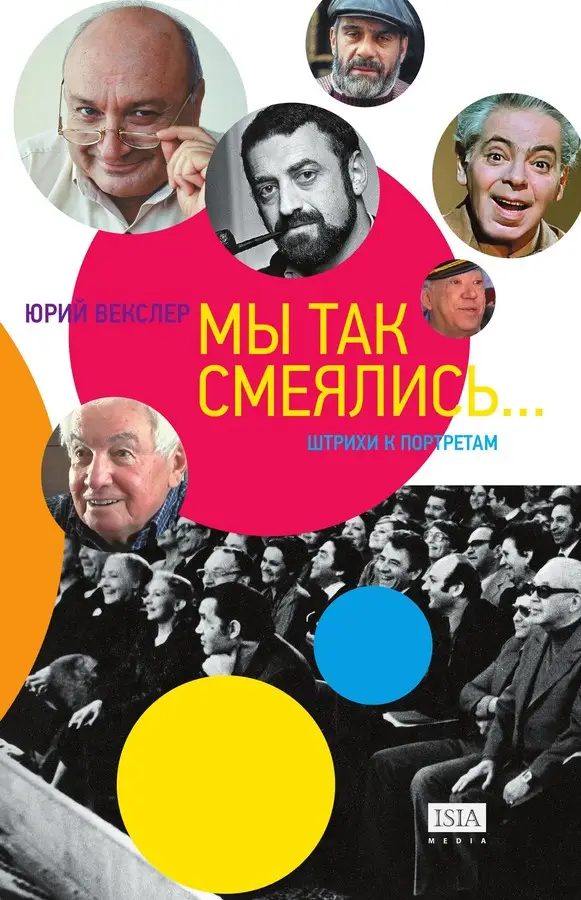 My tak smeialis’... (This Is How We Laughed...)ISIA Media, 2026
Yuri Veksler
This book, by a leading specialist on Fridrikh Gorenstein’s legacy is, in the first place, a memoiristic Jewish history of Soviet humor. Its central figures are Arkadii Raikin, Aleksandr Shirvindt, Grigory Gorin, Mikhail Zhvanetsky, Arkady Arkanov, and Valentin Gaft. Jewish humor in this history has to interact—sometimes quite productively—with the fact that all things Jewish were unofficially half-banned in the Soviet public discourse, and seen or, rather, presented as awkward or even improper. Thus, the humor stands out against the backdrop of latent Soviet antisemitism, and even becomes the protagonist, predestined for a constant yet optimistic struggle for survival. In terms of structure, the book looks odd: Veksler will often begin telling someone’s story, then suddenly break off and write something like, “continued on page 243” or “see below.” Why he does this remains unclear. After all, this book is neither a hypertext with instant links, nor the front page of The New York Times. Other authorial choices also contribute to the sense of disorder: Veksler abruptly shifts from narrative to, say, a transcript of a group stand-up show or a full-page quotation from Dovlatov; uses different fonts for the main text and anecdotal inserts; provides an abundance of photographs—some quite interesting, others just snapshots of everyday life, not always explained in captions.
-
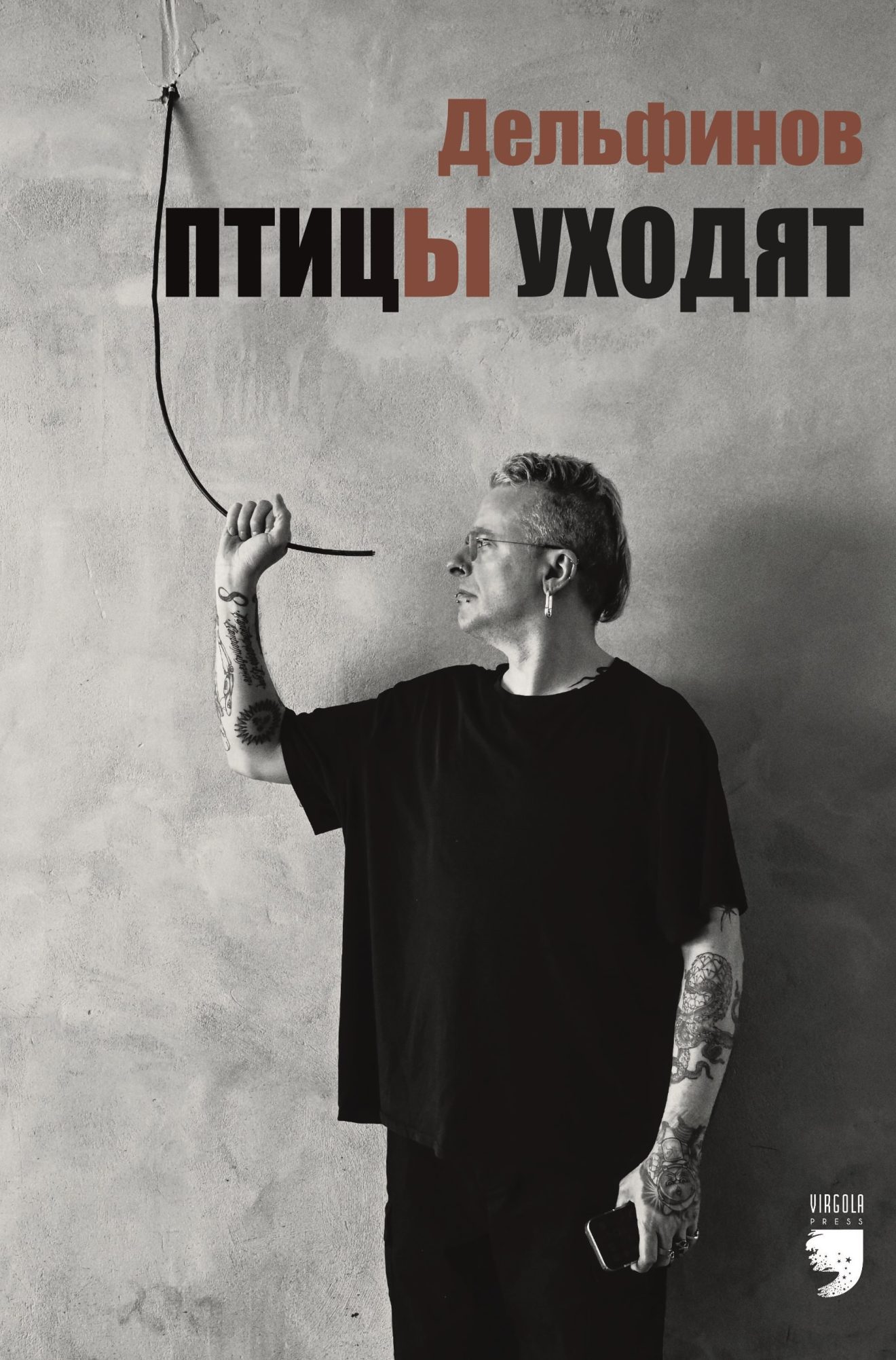 Ptitsy ukhodiat (Birds Walk Away)Virgola Press, 2026
Aleksandr Del’finov
In the preface to this collection, the poet Aleksandr Del’finov tells us about his first encounter with systemic, institutional violence—which, in his unoriginal but entirely valid opinion, shapes the psyche of anyone born and raised in Russia. Comparing himself to Soviet dissidents, Del’finov, like them, does not confine himself to “civic poetry.” Of course, uncompromising poems about Russia’s war against Ukraine—laments, ballads, blues—have an important place in this collection. They utilize tropes that have already become commonplace—for example, the one on the “endless February”: “A missile explodes right in the center of Kherson / on February 365th”—but also brutally rework material from classic poetry, mock the official jargon of directives and the propaganda of “Radio of a Thousand Moscow Hills” (behind which lies the reality of murder), and turn this violent material into pictures full of surrealism and sarcasm. Finally, the poems show how close the war is to the poet: “When friends’ children die, / Something in the world is broken beyond hope.”
At the same time, the poems about Soviet childhoods reveal that the world broke much earlier. Any idyllic feelings quickly collapse, and some memories, at first glance ordinary, show that the child who will later become an empathetic poet could readily reproduce the logic of bullying. It’s interesting to compare Del’finov’s work to Lev Rubinstein’s: the latter used the theme of Soviet childhood in an anthropological effort to lift—but not destroy—the nostalgic veil that covered this subject. In Rubinstein’s works, we encounter the recurring character of Smirnov, his childhood friend. Del’finov’s Smirnov is an alter ego, split off from the author (Smirnov is the poet’s real last name). Violence against the individual perpetrated by the state, politics, the sex industry, and even the pervasive depressive mood are leitmotifs of these poems. Their neuroses nest in the fear that anything can be done to a person—and that fear won’t subside. The collection’s title, Birds Walk Away, comes from a response by an early version of ChatGPT: asked who Del’finov was, it provided several nonexistent titles. The real Del’finov liked one of them enough to turn this hallucination into reality. Is this a story with a happy ending? Not necessarily.
-
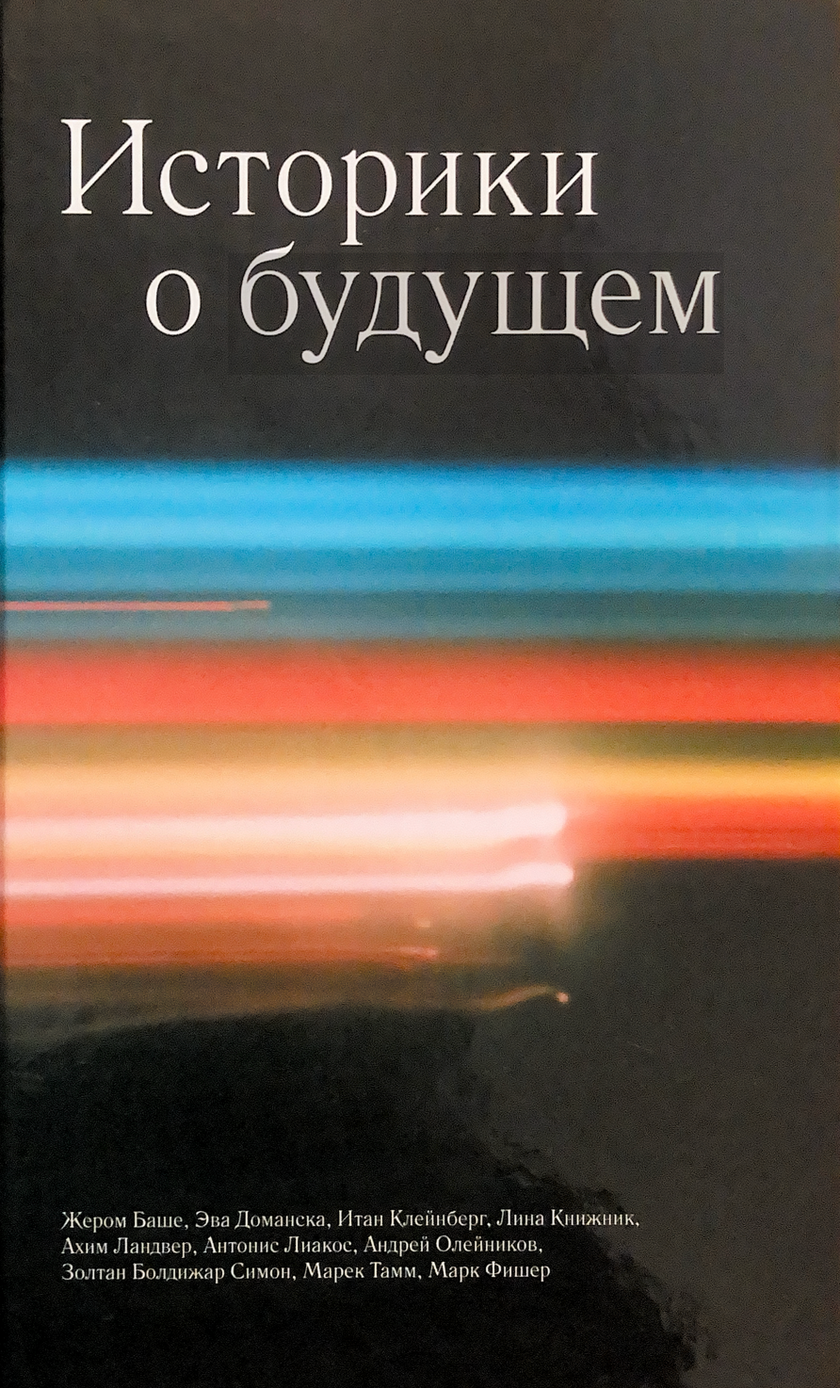 Istoriki o buduschem (Historians on Future) Überbau, 2026
The essays in this collection take on a subject that, at first glance, should be off-limits to historians. Yet, as the volume’s editor Andrei Oleinikov puts it, “the obsession with the future is becoming so total today” that historical extrapolation allows us to say something important about it—including by revisiting the very turn in modernity at which the future became a conceptual category in the first place. Obsession notwithstanding, the absence of the proverbial “image of the future”—at least a positive one, something other than a global radioactive dump—seems a particularly intriguing problem: as one contributor, Ethan Kleinberg, writes, the present is marked by an almost complete exhaustion of the social imagination. People are tired, my lord.
Some of the works here are well known to Western readers—for example, Zoltán Boldizsár Simon and Marek Tamm’s programmatic “Historical Futures” and Mark Fisher’s “What Is Hauntology?” The future is discussed in these essays from different perspectives: they analyze the rupture of the modern unity of future and past, the vulnerability of the researcher’s position to the temptations and violence of colonialism, and the role of a historian or a visionary during a permanent crisis like the one we’re experiencing. Russian scholarship is represented by Lina Knizhnik’s essay “Toward the Horizons of Historical Expectations,” which challenges Svetlana Boym’s distinction between “restorative” and “reflective” nostalgia. According to Knizhnik, these categories explain nothing and fail to demonstrate how reflection on nostalgia can contribute to political analysis. In Knizhnik’s opinion, nostalgia can serve as a means of “temporal protest.” If one thinks of the nostalgia for political predictability and dignity, this may well be true.
-
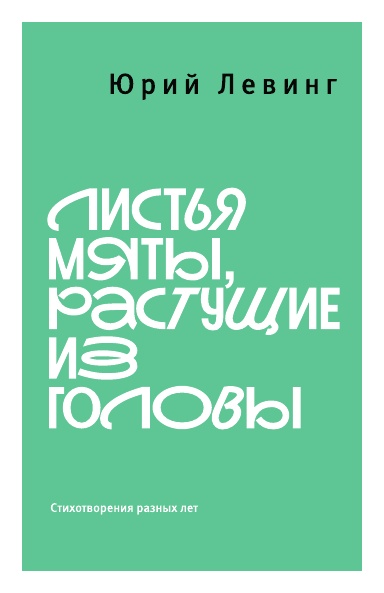 Listia miaty, rastuschie iz golovy (Leaves of Mint Growing from the Head)Sintaksis, 2026
Yuri Leving
This collection brings together poems of the philologist Yuri Leving that were written over several decades. Largely, these poems are written in free verse, but at times Leving employs regular verse—in a more lyrical key, they remind the reader of Mikhail Gronas; in a more “social” one of Elena Fanailova. The most interesting compositions are those where the prosody of free verse is combined with strophical structure: every four-line, three-line, or ten-line stanza is a single packed thought. The way these units (of which there may be four or five, or several dozen) form a coherent picture makes one think about seriality in contemporary art. Leving likes to enumerate, and from enumeration arise ironic paradoxes: “A decent death: / a week of mourning on Facebook, / with reposts. // A good death: / three days of memories on Facebook / with sad emojis. // A normal death: two days of melancholic reflections / on Facebook. // A solid death: / a notice in a black frame / on the local newspaper’s last spread. // A bad death: / died without even himself noticing.”
The reverse chronological order of the book allows us to take a trip back in time, from catastrophe to pre-catastrophe, from the age of two wars and a pandemic to the time when one could travel freely—and when a poet could feel they only needed to say a few words about some peculiar, uncommon things that were revealed to them alone, offered to their eyes only. The lines “During the downpour / tracer ropes / of transparent bullets / hitting the cobblestones / ricochet / like a frantic dotted line / disappear / like floats / that broke loose from the line” read differently today from ten years ago. Accordingly, the poeticized details of the deaths of Mary Stuart or Yuri Gagarin are a different kind of shock content in 2026, from inside the reader’s microcosm of equally acute and dull feelings, compared to 2013. That being said, Leving on the whole doesn’t stand on ceremony with death, or, rather, with the common, default reverence toward it. Reminders of death tear the fabric of his slow and melancholic textual flow. Those ruptures make his poetry comparable to that of Andrei Sen-Sen’kov or Fedor Svarovsky: all three have the ability to retell a well-known fact in such a manner that the reader will stare into the void for several seconds.
-
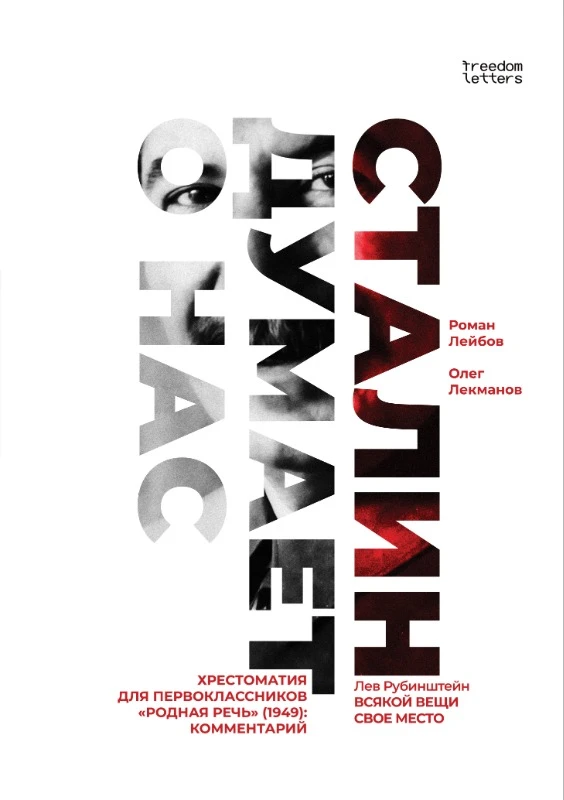 “Stalin dumaet o nas.” Khrestomatiia dlia pervoklassnikov “Rodnaya rech’” (1949): kommentarii (Stalin Thinks About Us. The First-Grade Reader “Native Speech” (1949): A Commentary).Freedom Letters, 2026
Oleg Lekmanov, Roman Leibov
Two distinguished literary scholars (one of them, Lekmanov, has been labeled a “foreign agent” by the Russian state) have decided to comment on a textbook that shaped the early reading and conceptual world of Soviet first-graders in the late Stalin era. Lekmanov and Leybov even propose a hypothesis that’s hardly verifiable, but still noteworthy: the textbook may have influenced members of present-day Russian leadership, who learned from it in school. Rodnaya rech’ is reproduced in facsimile, from Sergei Mikhalkov’s poem about Stalin ceaselessly thinking of the Soviet people (this myth of the sleepless leader is also examined here) to the lyrics of the Soviet national anthem, also penned by Mikhalkov. Between these two texts, one can find simple stories about school and family, work and animals, town and country, hygiene and Pioneer camps. And, of course, about the godlike Stalin, who towers over it all. The classics included in the textbook are not only ideologized by their context, but also damaged by cuts (for example, any hint of religion is removed) or additions. The textbook’s compilers didn’t hesitate to invent another stanza for a poem by Pleshcheyev or turn the loggers in a pre-revolutionary text by Sokolov-Mikitov into kolkhoz farmers. A sentimental piece is attributed to Tolstoy, although he never wrote anything of the sort; passages from Odoevsky or Nekrasov are taken out of context (and sometimes restoring that context gives the textbook a macabre quality). Rhymes that are “too sophisticated” are cut. All this seems to cast some doubt on the claim that Russian classics per se are to blame for the people’s indoctrination.
Lekmanov and Leibov have approached their task with both the usual philological scrupulousness (which often takes them beyond the texts under discussion) and a wit that is sometimes caustic. Thus, after quoting the panegyric text called “What Has Been Accomplished in Accordance with Lenin’s Teachings,” they remind us of terror inflicted on the Soviet population in accordance with those very teachings. Quite interesting is their idea of the “natural-grammatical” canon of Soviet literature, a kind of “forest ghetto” reserved for the short stories of Prishvin, Bianki, and Paustovsky. It appears that distinctive and stable psychological types were assigned to animals in Soviet animal writing—apparently inherited from pre-revolutionary classics. The coda to the commentary, a close reading of the Soviet anthem’s “Stalinist” version, is also impressive. Yet the commentators’ chief achievement is their reconstruction of the textbook’s narrative logic: individual texts that came into Rodnaya rech’ from very different sources are arranged specifically to pass the torch of ideological indoctrination, and the only thing that can help one find a gap in this relay is (post-)ironic defamiliarization. So it’s quite logical that the book ends with Lev Rubinstein’s essay on Rodnaya rech’: in one of his last pieces, the poet juxtaposes the textbook’s normative texts with the real events of his own childhood.
-
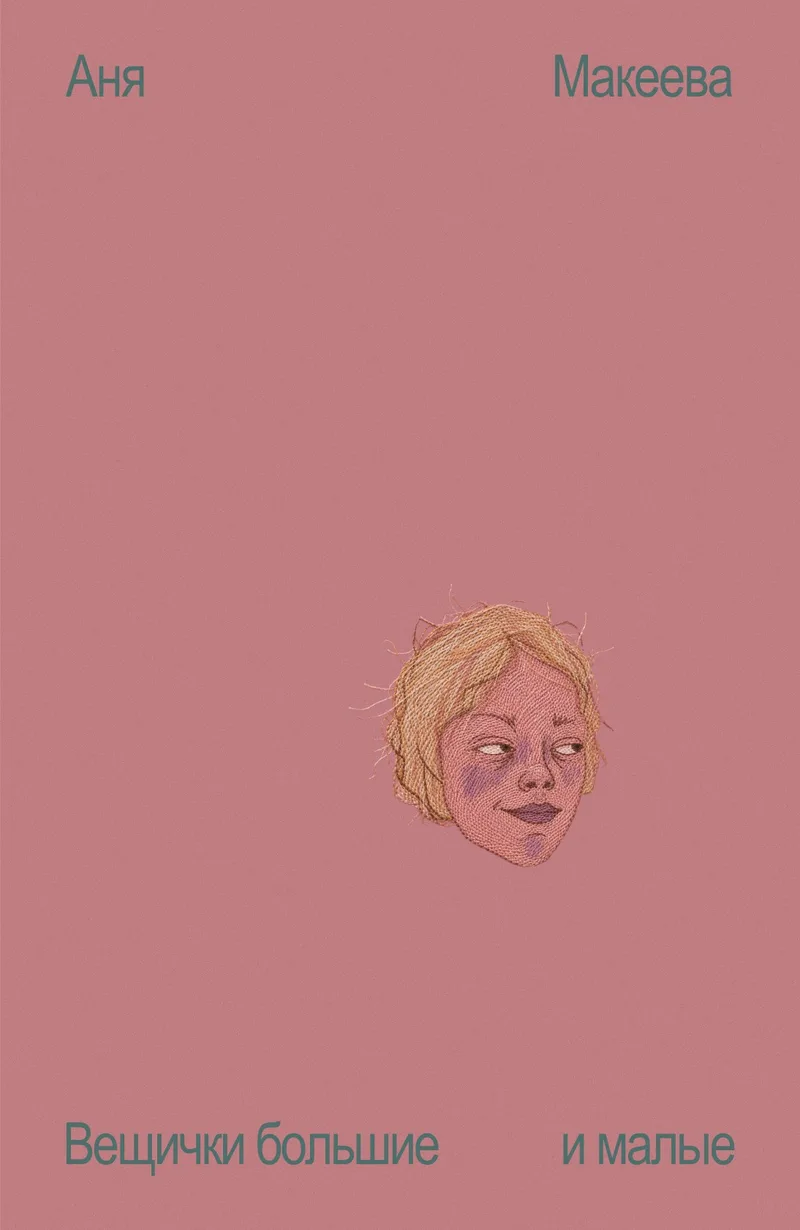 Veschichki bol’shie i malye (Large and Small Thingies)shell(f), 2026
Anya Makeeva
This book is a collection of short stories with a single protagonist named Marina. Having dropped out of a theatre institute with its unhealthy personality cult around the artistic director, Marina becomes a writer. She lives with her parents, who turn from nice people into abusers before the reader’s eyes. She dreams of moving to America and loves old things. So the narrative, stuck between fiction and autofiction, revolves around these objects, or “things”: it can be perfume, the father’s belt, a red jacket—or, in an homage to another book that portrays a life through objects, a suitcase—though Makeeva’s book owes much less to Dovlatov than to Natalia Meshchaninova and Alla Gorbunova.
Each object leads in its own direction, but all these directions come close to the edge, beyond which realism becomes phantasmagoria: the belt takes Marina to a land of dangerous hallucinations, a broken iPhone leads her out of totalitarian humiliation. Even a correspondence on social media that documents a stalker’s progressive descent into madness can be called a “thing.” Makeeva utilizes a recurring plot pattern: a pathological situation escalates, then is followed by an abrupt, deliberate escape, in the spirit of Nabokov’s Cincinnatus C. Emigration, then, is the ultimate escape, after which the orphaned, hapless things will have to find new owners, or head for Avito. Right here, at the end of the book, there will be an unexpected twist.
-
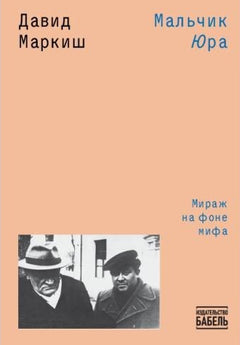 Mal’chik Yura (The Boy Named Yura)Babel, 2026
David Markish
Yuri Olesha was once the first reader of David Markish’s prose. Now, decades later, Markish publishes a novel about Olesha that quickly turns from conventional biographical fiction into phantasmagoria. Actually, “free fantasies from the life” of a given historical figure are Markish’s usual method. Here, these fantasies grow from the extraordinary world of Odesa at the turn of the 1920s—the world that had created the “Southern School” of literature. Another source is the far gloomier literary world of Stalinist Moscow. Alongside the titular boy Yura, the novel features Kataev, Ilf and Petrov, and Babel; their stories are woven into the larger history, about which Markish writes with the persistent, unkind irony of a veteran antisovetchik.
Of course, this novel cannot be taken for a documentary account, although there’s plenty of authentic detail (for example, Olesha really did joke about the island of Borneo—Ilf and Petrov probably borrowed the joke from him). Monya Rivkin represents the writer Veniamin Ryskind (Riskin), a close friend of both Olesha and Babel—but Kubat, Olesha’s interlocutor in Ashgabat, is imagined. He’s something of Olesha’s double, one who has achieved the freedom that eluded the protagonist. The scenes in which Stalin repeatedly spares Olesha’s life (perhaps these scenes are influenced by Grossman and Solzhenitsyn) are, of course, based on the author’s own mythology.
Olesha’s style is complex, yet light. The latter cannot be said about Markish’s prose: it’s dense, rich in difficult phrasing and anachronisms, but it shares Olesha’s love of metaphor. Markish also places much trust in generalizing maxims. This gives the novel a moralizing quality that Olesha seems to have avoided.
-
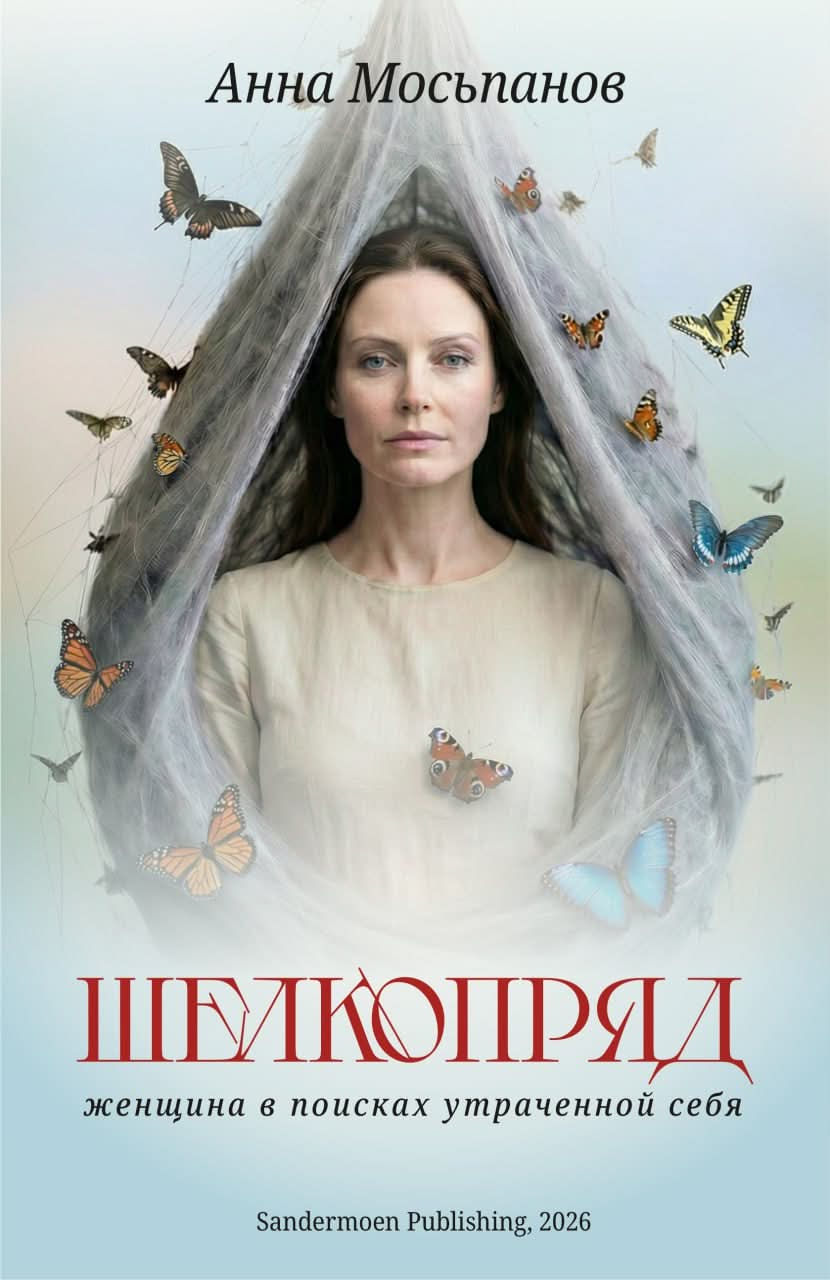 Shelkopriad (The Silkworm)Sandermoen Publishing, 2026
Anna Mos’panov
A pulp novel is no longer a surprise in tamizdat. Rather, it’s a sign of its health. Well aware of the genre’s conventions and clichés, Anna Mos’panov has her protagonist spell them out herself. So, we have Katya, a forty-year-old Slavic studies professor who emigrated long ago and now teaches at one of Montreal’s universities. She has a husband, Eric, a professor of Scandinavian studies, two children, and a friend, Zoya, with a complicated past and a not-so-sophisticated speech. (Eric’s speech is so sophisticated that he uses the word “chelyad”—servants—which he learned specifically from Russian literature.) Next, we have stereotypes about marriage in middle age. The husband hasn’t just grown cold—he’s always been cold, and Katya’s impulse to throw herself at him in a public place gives way to irritation at his general inattentiveness, pedantry, and questionable virility (he’s a sort of Canadian Karenin). Finally, we have a couple of candidates for an affair: a photographer from New Jersey and a Tajik migrant worker whom Katya meets in Tenerife, immediately falling for his formidable torso beaded with sweat. Addressing herself now by her married name, now by her maiden name, Katya moves toward adultery—but hers isn’t the only guilty conscience, and the novel’s pages light up with the sound of slaps. The narrator’s refined manners flake away, revealing a hysterical woman with a whiff of mundane xenophobia. The melodrama is heated by unexpected, tragic flashbacks. So, it seems like there’s nothing to discuss here—yet we have just enthusiastically retold half the novel. A page turner, so to speak. On a more serious note, such a book should probably be judged by rules I know little about—but its audience knows them well. One can hope they will enjoy it.
-
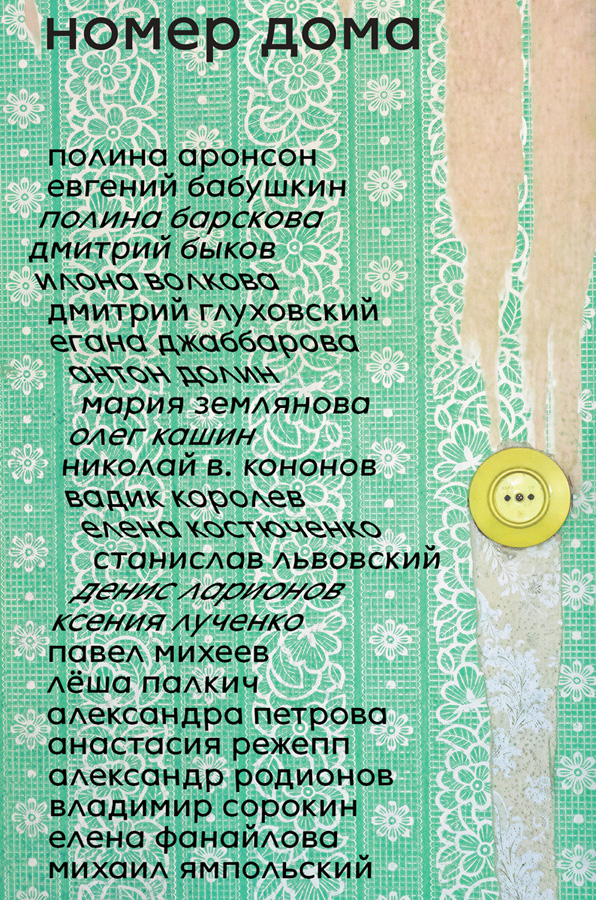 Nomer doma (House Number) Vidim Books, 2026
In emigration, home becomes a very problematic category. This new anthology of 24 authors is built on the recognition of this fact. What is home, how did we lose it, how do we remember it, can we find a new one? These questions are explored in Nomer doma (The House Number), a collection of essays and short stories whose contributors include Dmitry Glukhovsky, Yegana Dzhabbarova, Dmitry Bykov, Polina Barskova, Elena Fanailova, Oleg Kashin, and Elena Kostyuchenko. A new play by Vladimir Sorokin crowns the volume. The texts are, naturally, very different. Glukhovsky’s is a nostalgic essay, stylized in an old-fashioned manner: he speaks about the house of his grandparents, to which he can never return for real. Fanailova assembles her piece from correspondence in which home means longing for worrying about loved ones. Polina Aronson writes about how modern technologies that enable homestays force us to “standardize uniqueness,” depriving home of something essential. Anton Dolin considers how the motif of losing a home in contemporary cinema echoes his own life. Some contributors approach the subject through their research: Polina Barskova recounts the fate of Ivan Elagin, a poet from the Second Wave of the Russian emigration—the generation of DPs (displaced persons) she’s currently studying—who lost his home many times. Mikhail Yampolsky examines the motifs of losing home and returning to homeland in Heidegger and Celan. The second part of the book is dedicated to fiction. One short story worth noting is Denis Larionov’s contribution, in which a refugee camp resident, having injured himself on a metal fence, has to tear up a T-shirt bearing the slogan “We Don’t Influence Anything” to make bandages. Interestingly enough, many texts feature virtual journeys home via Google Maps: desperate walks through frozen streets on the other side of impenetrable glass.
Despite all these differences, the collection can be said to have a common tone—bitter, but not entirely bleak. The exception is the final section, “2nd Dead End,” where one can find a short story by Anastasia Rezhepp in which Home is the nickname of a vibrator, and Sorokin’s “Violet Snow,” a phantasmagoria quite typical for him: the play turns a simulation of “normal” drama into ritual ecstasy. Finally, the collection includes a story about a Ukrainian home: the protagonist of Ilona Volkova’s “What?!” cannot bring herself to leave her apartment in Kharkiv (on Dostoevsky Street, now renamed Sylikatna), and literally grows into it. It would be strange not to find in the anthology a text written from this perspective—even if it makes some of the other pieces seem lightweight by comparison.
-
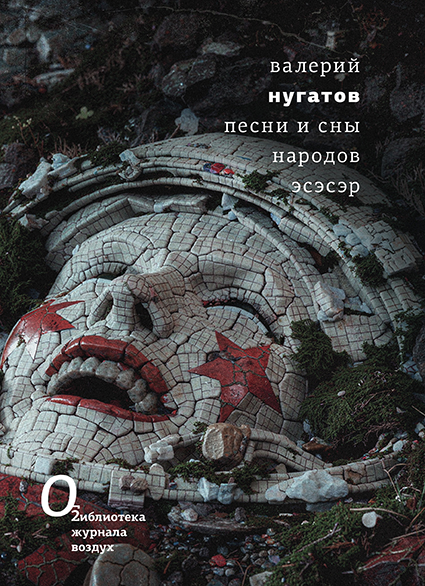 Pesni i sny narodov eseser (Songs and Dreams of the Peoples of the Uesesar)Literature Without Borders, 2026
Valery Nugatov
Valery Nugatov, one of the best Russian translators of French and English transgressive prose, spent several years writing serial poetry that varied linguistic clichés and sound patterns ad nauseam. Online, he adopted the persona of Deduzhgo Khossan, a parodic figure based on a Russian mafia boss that was murdered in 2013. Khossan spoke in a language distorted almost to the extent of gibberish—and, like his creator, caustically questioned every possible ideological discourse. By 2026, Nugatov has grown weary of both roles. In one poem of this new collection, he paraphrases Pushkin: “I’m tired of list poems in free verse / everyone writes them now following my lead…” The new Nugatov returns to the rich possibilities of the traditional syllabo-tonic prosody. In this collection, one can discern echoes of Georgi Ivanov, Aleksandr Galich (who deliberately squeezed poetry out of propaganda clichés), Brodsky, Alexei Tsvetkov, and early Roman Osminkin. Nugatov releases the potential for buffoonery still inherent in rich, savoury rhyme—but this buffoonery is mirthless. The poems are full of terrifying depictions of the brutal, senseless war—and of a society accustomed to the hell it keeps reproducing (“you’d never guess that / a roll call in hell is about to begin”).
-
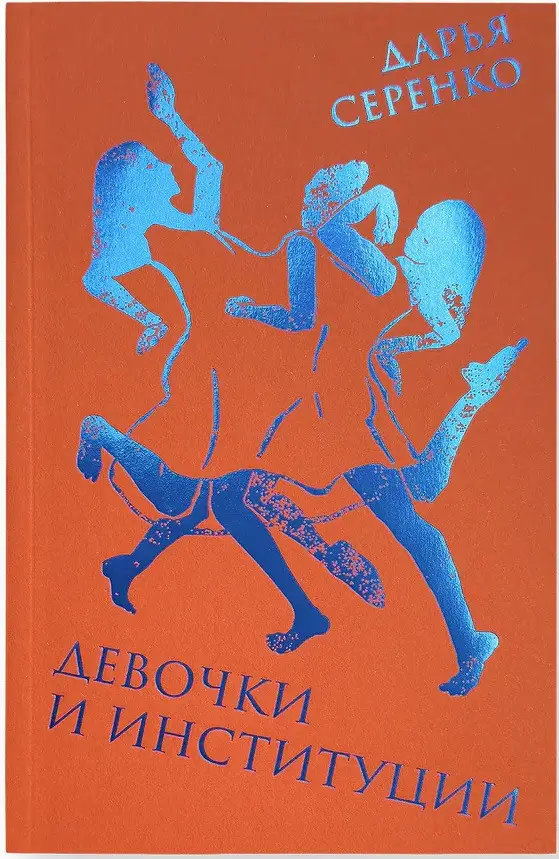 Devochki i institutsii (Girls and Institutions)One Book Publishing, 2026
Daria Serenko
The first edition of this book was published and became successful before Daria Serenko became a political émigrée, a “foreign agent,” and one of the most prominent Russian anti-war activists. The new edition is “revised and expanded by the author in accordance with the spirit of the times,” and now includes a “preface by a girl who has outgrown her institutions.” It opens with a brief, uncompromising inventory of the horrors of the five years since 2021: war, deaths of political prisoners, repression against LGBTQ+ people. But it also speaks of resistance—not widespread, but vocal—that began in the very first hours after February 24, 2022 (Serenko was directly involved as a co-founder of Feminist Anti-War Resistance). Another addition is a selection of anonymous stories of women who continue working in state cultural institutions and protest against the war clandestinely. “I want all the collective, invisible work we girls do in unbearable conditions to become visible. I want our involuntary anonymity to fall like a heavy mask.” One day this will happen—in a good sense, of course.
The core of the book, which is several stories about the inside world of state cultural institutions, stays unchanged from the original. Through defamiliarization, this world at times strikes the protagonist-author as bizarre, at times excites her with the feeling of belonging—not only to a particular gallery or library, but to culture in all its institutional manifestations. This is culture as ritual, through which the faces of living people, normally unnoticed, become visible. Defamiliarization works especially well when it comes as a shock: “The days when grief takes power in your office are the clearest and brightest days if you work for the state. You look into the eyes of someone to whom something irreparable has happened and you feel like everything around you turns into pathetic decorations, cardboard walls that will collapse as soon as you look at them with another optics.”
Russian-speaking and non-Russian-speaking readers will probably react to Girls and Institutions differently. The former will feel bitter recognition and nostalgia: indeed, Moscow’s pre-2022 museums, libraries, and exhibition halls functioned largely thanks to the “girls” with humanities backgrounds; they took these jobs to earn at least something in their field and managed to create interesting, viable projects despite countless bureaucratic obstacles. All this has collapsed and is gone forever, and there are more urgent and serious things to mourn. The non-Russian-speaking readers will encounter a rather surprising and peculiar world in which national particularities coexist with such international phenomena as precarity and silencing of women’s labour. To quote Ksenia Psevdonimova’s preface, “Culture is hierarchical, like Putin’s power vertical, we are told; and at the top of the hierarchy stands the artist—most likely a man or woman from a family with a long intellectual heritage, while at the foot of their pedestal the girls bustle about: they bring paints and brushes, serve as muses, clean the room before an exhibition, cook, fill out strict bureaucratic forms, falsify attendance figures for people and animals, do the bookkeeping, go to prison if embezzlement is uncovered.” Most likely the war changed little in this order. “Girls” is a self-designation for a community that becomes almost a single organism: a girl can be any age, she can be given a retirement send-off party. Even a surveillance camera can be a girl. Another internationally recognizable motif is tilting at windmills. Between blows from their sails, it’s possible to produce not just something of merit (say, a good exhibition), but also something tragically witty, something that can become a symbol beyond the immediate task—such as showing the administration a photograph of nonexistent visitors: “… the girls told the security guard to wrap himself in a fluffy shawl and sit on a chair. That’s how we got a dramatic photo of an empty hall with a solitary woman in a shawl.”
-
 TaimeMeduza, 2026
Vasily Chernyshev
This short novella by the poet Vasily Chernyshev is about emigration in 2022, wanderings through Georgia and Poland, and a brief return to Moscow in 2025. The story is very common, but it’s saved by Chernyshev’s style, remarkable for its attention to the relationship between language, time, and the protagonist’s emotional state. Filth and disorder are described in filthy, disorderly words; tenderness toward a girlfriend left behind in Moscow reaches lyrical heights. Taime is short for tainoe mesto, “secret place.” Initially a name of a street nook in Moscow, after the protagonist’s emigration this word encompasses the entire pre-2022 city. Returning there in 2025 reveals what many recent émigrés still don’t know: that city, those places, that language are gone. “In the evening, friends come over, like a ball of colored threads”—this is a memory of the past; those threads are gone too. One can only ask, in bewilderment, the childish question: “How the fuck did it all get lost like this?” Chernyshev invokes multiple tropes and memes of the discourse surrounding “those who left and those who stayed,” from émigré slums that briefly became cultural melting pots for very different and very strange people to Moscow’s proverbial Patriki (Patriarch’s Ponds) and Vkusno i Tochka (ex-McDonalds). There are also less obvious details: for example, the Moscow Poetry Slam appears in the novella as “Skhlyost” (“Clash”, a well-coined Russian neologism). In both temporal and spatial layers, Chernyshev’s narrative occasionally starts meandering toward macabre phantasmagoria—here, Taime can be compared to another successful work of émigré writing, Dinara Rasuleva’s Traumagotchi.
-
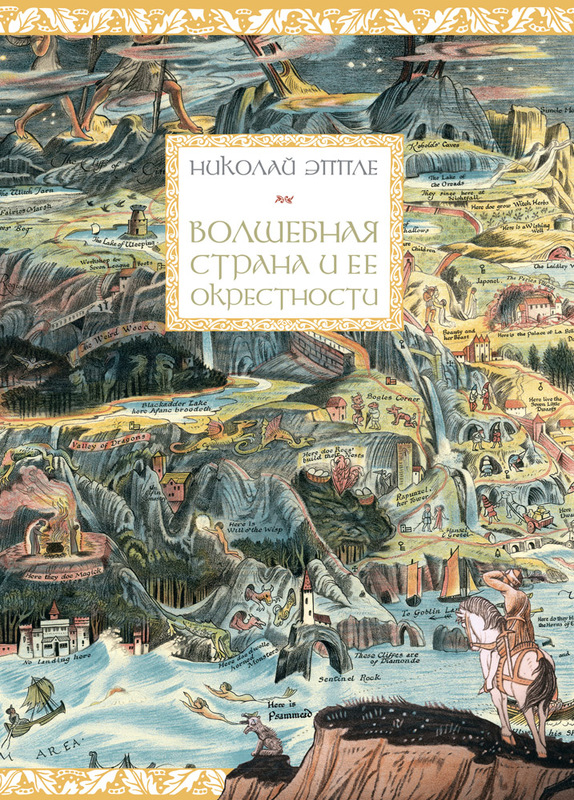 Volshebnaia strana i ee okrestnosti (Fairyland and Its Surroundings)Vidim Books, 2026
Nikolai Epple
This is a colorful new edition of a wonderful guide to English fairy-tale literature. For Nikolai Epple, it’s a single realm, a fairyland whose regions are interconnected: Carroll, Grahame, Lewis, Tolkien, Rowling, and others (the essay on Chesterton stands somewhat apart). Fairyland is not only the genre itself, but also its central subject: English authors have been especially successful at creating imaginary worlds in which readers of any age want to stay. Epple underscores that the audience does not merely consist of children and approvingly quotes A. A. Milne’s observation that “no one can write a book which children will like unless he writes it for himself first.” Behind the corpus of fairy-tale literature rises the structure of the entire British tradition, founded on Anglo-Saxon tales, Arthurian legends, and Christianity (the Christian roots are evident not only in The Chronicles of Narnia, but also in Tolkien’s legendarium and in Harry Potter). Epple begins tracing this tradition from George MacDonald and shows its continuity into the present, when it begins to parody itself, as in Pratchett. His essays give separate attention to Russian translations.
-
 Lev Oborin
A poet, literary critic, translator, and editor-in-chief of The Tamizdat Review. He has authored eight collections of poetry, a collection of reviews, and a book of poetry for children. His poems and articles have been published in Poetry, International Poetry Review, Gazeta Wyborcza, Novy mir, Novoe literaturnoe obozrenie, Vozdukh, and other outlets. He has served as an editor of Polka, a website dedicated to Russian literature. Oborin holds an MA from the University of California, Berkeley, where he is currently pursuing a PhD. He is a recipient of the Andrei Bely Prize for his criticism (2021).