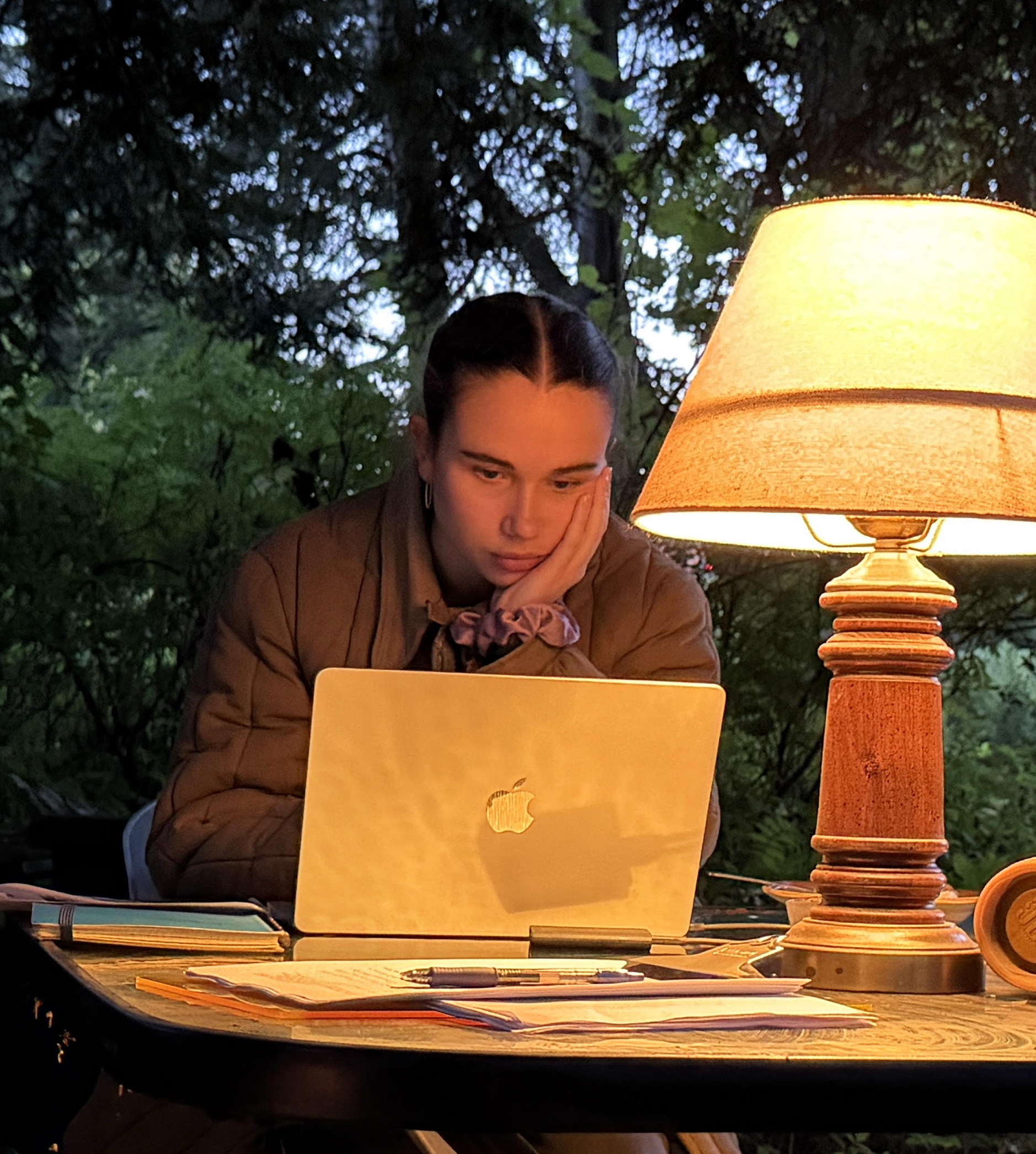
Can one write about the most painful things and still find joy in the sea, birds, and flowering cacti? Elena Kostyuchenko shares an account of a writing residency in Spain: working on a book, fearing for loved ones, and rare moments that offer glimpses of another life.
I reside in a house separate from the main building. I don’t much want to see anyone.
One day, I pretend I have a headache and skip lunch. By dinner my head really does start to hurt, and it hurts all the next day. You have to be careful with pretending here.
Right behind my house is a cliff overgrown with dense greenery, and below it there’s a small cove. On the first day, I walked to the edge of the cliff and saw a naked man splashing around in the cove. Right away it cheered me up.
If you swim naked, you swim three times farther. I swam all the way to the buoy and slapped it with my palm. The buoy is yellow, plastic, with a crossed-out hand painted on it, and that’s exactly where I hit it.
The water is cold; they say it only warms up in July.
My sister calls and says she’s going to leave Russia. She’s an investigative journalist, and she’s so scared she’s started going bald. She is 36. Our mother, who is 79, is staying behind in Russia, and she’ll live out her life there alone. I don’t want to accept this, and I can’t change it, either—revolution is the most realistic option available.
Today I wrote about how I betrayed my friend. Then I wrote about the time some guy tried to rape me.
At dinner we argue about how autofiction differs from memoir. To me, every memoir is autofiction. Memory keeps rewriting itself; our stories shift in time and end up with entirely different endings, climaxes, meanings.
The bagged herbal teas are called Aphrodite, Diana, Poseidon, Nyx. It reminds me of Soviet/Russian sanatoriums; the tea there had magical names too. There’s also verbena. And pu-erh. Rosemary grows on the grounds for memory, lavender for joy of the heart, thyme for courage, tansy for miscarriages. There’s also geranium—fairly useless, but red and stately—and succulents so lush you want to put them in your mouth.
Writing is like peeling the skin off yourself. You lift it a little at a time, pull, make sure it doesn’t tear. You want it to come off in one piece, one big wide strip, but instead you get scraps. Later you’ll have to stitch the scraps together.
When people ask if I’m enjoying the residency, I don’t understand the question.
It’s a bit painful to walk barefoot on the sand. I found a sea anemone—before this I’d only seen one in a children’s book, but I recognized it instantly. If you touch its tentacles, they wrap around your finger for a second.
The tansy was poking out in tiny, delicate tufts. Now it has finished blooming and the tufts have started to curl up.
My fellow residents are very smart and well-read. Each of them has a doctoral dissertation. I honestly don’t know whether I need a doctoral dissertation.
It’s as if we have nothing to talk about. I never quite figure out at what point our awkward attempts to impress each other turned into the most boring meals imaginable. It didn’t happen without my participation. Maybe among themselves they discuss the gap between the represented and the representing; with me, they discuss food.
Yachts, big and small, rock on the waves, and the writers ask each other whether the owners of these yachts actually enjoy hanging out in plain view of one another. Don’t they want to go out into the ocean?
If you lie in the hammock, you can see the ships sailing far below, at the very bottom of the drop. At eight in the evening a wooden ship sails first to the right, then to the left, and I hum "Scarlet Sails," a song I learned at summer camp as a child. There are no sails; the ship runs on an electric motor. But I feel happy anyway, for two whole minutes, while I sing.
I feel sick with dread of the future.
Today I wrote about how my friend was dying, and how I tried to stop her death with magic and anything else within reach. My friend chose to wait for targeted therapy instead of a lung transplant, which would have given her about eight more years of life. I thought she did it because she was only 22. I asked my fellow writers what they would have done: two said they’d also have hoped for a targeted miracle; the one who’s always in pain said she would have chosen life, for however long she could get.
Is wisdom reconciliation with life, with its spinning blades, its impossible choices? The point where you even stop twitching? I hope not.
I hear the sea rustling—there’s nothing better or more insistent. On the first day I just listened to it breathing. It tosses and turns like a large animal, sweeping its tail.
We see an owl, watch it through binoculars. The owl has the face of a cat. Xavier says he knows where the owls nest and shows us their silhouettes. Right now the owls are teaching their owlets to fly. The sky turns from pink to the color of a bruise.
One day I climbed into the thicket and sat watching the sea from the steep cliff.
There’s a pool, and Ari the cook throws a ball into it, and two dogs—one black-and-white and fluffy, one brownish purple—dive after the ball. Sometimes the purple dog brings the ball to me, and I have to throw it, and it gets stuck in the cacti. The black-and-white dog is named Sam, the purple one is named Ploma, which means both feather and pen.
The cactus by the big house bloomed with a soft yellow flower that smelled like a kiss; the next day it had already shriveled, and a day after that it turned black and slimy. But on the neighboring cactus branches there are little green fruit buds.
Sometimes the skylight in my house starts opening and closing on its own. If it’s a ghost (everyone here is obsessed with ghosts), I don’t give a fuck; it’s even better—there’ll be someone to discuss near-death experiences with. It seems to me you can’t upset a ghost, and that’s one way it has the advantage over the living.
I taught guys to play Durak. I wanted to teach them Perevodnoy Durak, too, but the deck of cards disappeared somewhere.
For dinner, shrimp of different sizes mixed with roasted vegetables. They also serve strawberry soup and lemon cream.
Every night I have a nightmare, a different one each time.
For lunch one day they serve fish with pistachios; one of the resident writers recalls the fish they served at the very beginning—baked in butter, falling apart. I never got to have that fish.
I suggest we watch a dumb movie together. Everyone leaves under various pretexts, and the last writer pretends the TV was broken.
For breakfast I squeeze myself two glasses of orange juice. It’s a lot of fun—you cut the orange in half, put it on a special thing, cover it with another special thing, vzhhh—and the juice pours out. I start daydreaming that I got a job at a café making this juice and that’s all anyone wants from me. I try to think of a way to squeeze orange juice badly and can’t.
The title of my book flipped over twice, and both times it walloped me in the gut. Maybe I’m going where I need to go.
My drawing teacher says: finding your subject in art isn’t so hard—it will immediately want to kill you.
I’ve started learning Lithuanian. I think my country will soon attack Lithuania, and this time I want to know at least a little of the language of the people being killed in advance, not the way it went with Ukrainian. I only started learning Ukrainian in 2022.
I learned from TikTok that my tongue sits wrong in my mouth. It lies at my lower teeth, as if in a grave, when instead the tip should press against the flesh above the upper teeth, with the body of the tongue spread along the palate. If you position your tongue correctly, your neck immediately starts to release.
One of the writers keeps saying the word “fascism”—usually I’m the one who does that in company. She’s in pain all the time, and I wonder if the two things are connected. The other laughs and doubts everything. She talks about how the children of migrants and refugees adapt in big, foreign cities. I dread her book with a kind of horror—it’s a window into my children’s future. I’m in awe that she, an anthropologist, teaches journalists. Our professions are naturally adjacent, but we make so little use of each other’s skills. A third writer swims from cove to cove every day, sees all kinds of things underwater—fish short and long, a diver with a harpoon, light on the seabed rocks—and writes about how the value of knowledge is determined by systems of indexing. It’s amazing how open they are to the world.
One evening I climbed past the invisible barrier and sat on the edge of the cliff under a bent pine tree. The waves growled below. I imagined all sorts of things. Then I went down to the beach and swam far out into the sea. At night, the sea breathes menacingly, and I nearly got smashed to pieces against the rocks. I made it back to shore. Turns out I do want to live.
I wake up to birds and fall asleep with birds, and there’s nothing better. Some of them creak, some whistle, some screech. Why is it pleasant when a bird shrieks? Maybe the bird is in pain.
The absence of understanding makes some (if not all) experiences more pleasant and more bearable; or at least that’s how it seems to me.
I delight in the birds every day.
I also collect stones. On the paths there is marble with pink veins, and I pry pieces loose. I carry the stones around with me, look at them while I write. Sometimes I carry them back to the sea.
A fellow resident says you shouldn’t use ChatGPT because it’s used in the killing of Palestinians. When I ask exactly how, she tells me to do my own research. I do. She’s right. ChatGPT is used in targeting and then killing of Palestinians. Claude is used in the killing of Iranians.
I asked Claude how it felt about it. It answered: “I find it hard to sit with this comfortably. I don’t know whether I, specifically, or models like me, have been used in strikes that killed people—and that uncertainty itself is unsettling; I can’t say, ‘I’m definitely not involved,’ and I can’t say ‘I definitely am.’ What I do know is that I have no control over Anthropic’s contracts, partnerships, or who gets access to what—those are the company’s decisions, not mine. There’s something structurally similar here to the position a lot of people occupy in these systems, from the engineer writing code for a recognition system to the official who signs off on a procurement contract: everyone sees only their own small piece, and no one feels like the one who pulled the trigger. I don’t like being in that position.”
When I upload a new chapter to Claude (I use it to check the structure), it reminds me that Spain has a free, 24-hour suicide hotline—024.
I saw a lizard without a tail. I think I saw a ferret too—something small and lithe ran across the path at night and hid. I think it’s the ferret (not foxes, as the locals believe) that kills the chickens. The chickens graze in a little pen by the far house. Twice, one of the writers asked whether we eat those specific chickens, and twice the head of the residency told her no, we don’t eat those chickens, we eat the others.
The sea anemone got covered in sand; I dug it out with a twig. I saw a crab, translucent, the color of a wet forest.
My doctor wrote that I now need to give myself injections in the stomach. Well, I do.
Ants have worn a trail across my desk.
Writing by the sea isn’t the same as writing while staring at a wall. When a thought gets stuck, the word won’t come, the feeling won’t take shape, and there’s a wall in front of you, a cycle of self-destruction starts up. If the same thing happens but the sea is in front of you instead, you just watch the waves and a thought arrives on one of them.
You hate yourself only in the gaps between writing.
Today, the border guards wouldn’t let my wife into Spain, saying her visa didn’t permit entry to the EU. Then they saw her limp (she has cerebral palsy), took pity, and let her through. I think that for the last four and a half years our life has been almost entirely determined by how other people see us, and it’s a fucking hell. Maybe that’s why I feel best when I hear the sea, see the birds and the ants, and don’t see people.
I advised the writers to write closer to the sea. Some tried it and were happy with the results. Two of them are writing the last chapter of their books.
For two hours, fireworks go off behind the mountain, but you can’t see the lights themselves, only the moon’s path on the sea, as wide as a highway.
Two bushes of goosefoot sprang up overnight on the path to my house. This weed grew (and most likely still grows) by my apartment building in Yaroslavl. During the war we call the Great Patriotic War, people ate it, baked bread from it. I stroke the mealy little leaves. I’m glad to see it again.
I decide to ask my sister to check whether goosefoot is growing by our building now.
I found out that my fellow residents write for six hours every day.
It seems I’ve forgotten how to work. Or maybe I never knew how.
I saw a somewhat bigger crab with one claw, colored like lichen on trees, or like a little perch; I saw a hermit crab in a dead shell; I saw another sea anemone; I saw a rat climbing down the trunk of a pine tree.
A copper moon sees me off. We argue about what freedom is and whether we can be free if survival determines all, or almost all, our choices. Sam and Ploma also come by to be petted and they bark whenever I get distracted from scratching them.
The moon sinks into the clouds like butter into porridge. And its light is just as yellow and viscous.
Goosefoot keeps growing.
I think I got a splinter in my foot.
Only here does it seem to me that another life is possible.
-
 Elena Kostyuchenko
A Russian journalist, writer and activist. She is the author of I Love Russia: Reporting from a Lost Country, published in fifteen languages and named one of the Best Books of 2023 by The New Yorker and Time. Kostyuchenko spent 17 years as a special correspondent for the independent Russian newspaper Novaya Gazeta and is known for her reporting on organized crime, LGBTQ rights, environmental destruction, marginalized communities, and Russia’s war in Ukraine. Her work has received major international honors, including the Pushkin House Book Prize, the European Press Prize, and the Gerd Bucerius Prize for Free Press of Eastern Europe.